22 January 2007

Book Banter -- Precursor


Title: Precursor
Author: C.J. Cherryh
Length: 438 pages
Genre: sci-fi
Plot Basics: Three years have passed since Bren Cameron, translator between the humans and atevi, helped the two races start the construction of a space shuttle after the old human ship Phoenix reappears. In a move by the ruler of the atevi world, Bren's suddenly aboard the shuttle, sent into space to negotiate with the humans on board to figure out how to rebuild the space station. Negotiations seemingly start well, but Bren and his atevi staff end up being near-prisoners on the station and Bren finds that he has to prevent the outbreak of a new three-sided human-atevi-human war between the station and the planet.
Banter Points: Cherryh does such a good job with alien cultures. The atevi feel foreign and it's interesting to watch the character interaction of those people on the space station react to them. Her plots take lots of build-up, but once the books takes off, it's a great story.
Bummer Points: Her plots take lots of build up. This is the first book in her second trilogy set in this universe, so a bunch of the beginning of the book goes over familiar ground for readers of the first three (Foreigner, Invader, Inheritor). She spends a great deal of time, again, telling readers why the atevi are different from humans.
Word Nerd recommendation: Still pretty good, though Word Nerd thinks that readers who read these as they came out with more time between books might have liked them more because all the repetition wouldn't be so close together.

19 January 2007

Making the classics sound good

We start Friday with a short quiz.

Q1. Who is Jonathan Yardley? *
a. That guy who edits the NYT crossword puzzles
b. That guy who reviews books in the Post
c. That other guy who reviews books in the Post; choice "b" clearly refers to Michael Dirda or Ron Charles
d. That guy who does the funny quizzes on the radio

If you picked "c" good for you.

In addition to reviewing new books, Yardley also from time to time reviews old books to talk about why they are good.

You can find his second reading column archives here.

Word Nerd read his review of Ernest Hemingway's "A Moveable Feast" and thought maybe, just maybe, she'd have to read this one. Hemingway is not one of the classics authors that Word Nerd ever wanted to pick up ever again after high school, having to read 100 pages of a guy chasing around a big fish. ... yes, she knows, that book is really about grace under pressure... Nevertheless, Yardley's review of "Feast" makes her at least interested where she wouldn't be before.

He recently took on "The Great Gatsby" and had this to say about it:
If from all of our country's books I could have only one, "The Great Gatsby" would be it.
Word Nerd whole-heartedly agrees on his pronouncement about Gatsby. She did, after all, name her feline roommate after Fitzgerald's dubious character.

What books that you read, perhaps in school, deserve a second look?

* Bonus points for identifying the person who belongs to answers "a" and "d."

18 January 2007

Too much of a good thing?

Word Nerd hasn't posted a book banter column in over a week.
Shocking. She knows.
Maybe this sounds odd, but Word Nerd's not that interested in reading right now.
Here's the thing: Word Nerd is enjoying the book she's reading, but it's 438 pages and rather slow-going at times as the author recaps stuff that happened in the first three books in the series. And finishing the book has just not been a priority.
Is it possible to get booked-out?
Is this just the by-product of not reading something that's a gripping page-turner? Or just that other things are taking up time (ie, trying to meet Word Nerd's self-imposed January writing goal and conquering the world in the computer game that Word Nerd's pater familias got her for Christmas? ...thanks Dad...)

Has this happened to anybody else?

17 January 2007

Author Answers with Syne Mitchell

Hey sci-fi fans -- this week's author is Syne Mitchell. Mitchell's latest book is The Last Mortal Man.

For more about her, check out her website.

WN: Why should a reader pick up one of your books?
MITCHELL: For a thought-provoking and fun read. I write what I call "firm SF" in that I work hard to get the science details right, but my real goal as a writer is to tell a great story.

WN: On your blog, you mention that Last Mortal Man will be the one and only volume in the Deathless series… as a writer, is it hard to let go of one idea and move on to the next project?
MITCHELL: I had the next two novels outlined, with the expectation that the series would continue, so yes, it was a disappointment when they weren't picked up. But I've got a head chock full of story ideas, so there's no end of material. My current project is something quite different: epic, modern day, a subtle twist of fantasy. I'm very excited about it.

WN: How much research do you have to do to get the science part of science-fiction to be real and/or believable? Where’s the line between the science and the fiction part?
MITCHELL: I have a background in science, and groan when I read a book or watch a movie with blatant scientific bloopers. When I taught, I often had to work to correct misconceptions that my students had picked up from entertainment media. So when I sit down to write a book, I try very hard to get the details right. Especially if it's a field like microbiology, which I haven't studied. I read books, ask questions through email, do scientific calculations, interview specialists, and even take tours of research facilities like genetics labs. Do I still make mistakes in my books? Of course. I'm only human. But I hope my readers give me credit for trying hard to get the details right.

WN: What’s your writing process like?
MITCHELL: I'm currently playing around with that, trying new things. Before, I always outlined each book, building a solid skeleton for the story before I wrote a word. Now I'm writing more organically, letting the story evolve as I go along.

WN: If you got stranded on a desert island with one of your characters, who would it be and why?
MITCHELL: Dyson Rader from THE LAST MORTAL MAN. (Dyson is actually Dixon Tully from TECHNOGENESIS with the serial numbers filed off. I loved that character so much that I sneakily brought him back under a different guise in my latest novel.) He's competent, sexy, smart, fun. The kind of guy who could probably find a way off the island; but with him around why would you want to?

WN: What is the best/most influential book you have ever read and why did it inspire you?
MITCHELL: It would be hard to point to just one. I love the work of Larry Niven, Tanith Lee, Peter S. Beagle, Spider Robinson, Ursula LeGuin, Octavia Butler, and gosh, so many more. I'm an omnivorous reader and in my school days would read a novel-and-a-half a day. (Thank goodness for libraries!) I loved different books for different things. Larry Niven's books for the brain puzzles, Spider Robinson's for the humor and heart. LeGuin's work for it's epic grandeur. Tanith's for the marvelous settings. The list is endless...

WN: What is your favorite word and why?
MITCHELL: Any word I know that my husband doesn't. Having two writers in the family, we get a bit competitive.

WN: What piece of advice helped you out the most as a writer?
MITCHELL: "Apply your bottom to the chair and write!" to paraphrase a quote from Marion Zimmer Bradley.

The most important thing about being a writer is to write. All the agents, editors, readers in the world won't be a lick of help if you don't write the darned thing down. If it's bad, you can always fix it later.

To put it simply: Writers write.

16 January 2007

Means something like...

A glimpse into Word Nerd's morning of writing and why word choice matters.

Please complete the following sentence:

This move back into the family apartments was nothing short of ___________.

Have a word in mind? Good. Focus on that word.

Now, step back. Word Nerd got as far as the "of" in that sentence and went, Huh. Just what was the move like. And what word fits the voice of my narrator? Horrendous? Awful? Stupendous? Lousy?

Word Nerd got out her handy-dandy thesaurus. Horrendous: horrible, frightful, terrible. Nope, none of those. She tried "grievous." Grievous had lots of choices, one of which led her to "outrageous." Likewise, "outrageous" had lots of synonyms. She even had to get out her dictionary to look up "contumelious." (She didn't pick that word, just in case you're wondering. This is a story, not an SAT vocab test prep book.)

Word Nerd's picked her word to fill in the blank, but isn't quite sure it's the one she wants. Words, of course, have meanings and shades and she wants to be sure she's conveying the right sentiment, which ever one she picks.

15 January 2007

More words of the year

Merriam-Webster's online dictionary also dubbed the top ten words of 2006.

They decided on words based on user submissions.

Their word of the year, truthiness.

To see the whole list, click here.

Again, bonus points for anyone who can post a sentence using any one of these words. Extra points and thumbs up for using more than one in the same, legitimate sentence.

12 January 2007

Please use the following words in a sentence

If you haven't heard, the American Dialect Society voted a week ago on the 2006 word of year.

And the winner is, "pluto" as a verb, as in "to pluto/be plutoed," meaning to "devalue or demote something/someone."

The word comes from the decision to revoke Pluto's planetary status and demote it to a dwarf planet. As in "The astronomers plutoed Pluto."

The press release from the Dialect Society is here, explaining "plutoed" and the other runner-up words in a bunch of different categories.

Looking at all these words, Word Nerd's not sure she can appropriately use them in a sentence. Bonus points to anyone who can post a sentence using "plutoed" or one of the other words. Bonus bonus points for using more than one in the same sentence.

10 January 2007

Author Answers with Marcus Sakey

Better later than never on a Wednesday, this week's spotlighted author is Marcus Sakey. Sakey's debut novel, The Blade Itself, hit shelves yesterday.

Early reviews of the book have been top-rate, including a starred review in Publisher's Weekly and the book being named a January pick by BookSense.

For more about Sakey, check out his website.

WN: The Blade Itself just came out. What should readers know about it that will compel them to go pick it up?
SAKEY: The biggest compliment I've received was from a woman who emailed to say she called in sick from work because she was 170 pages in and didn't want to quit. I think before anything else, novelists should be compelling storytellers, so that made my day.

WN: What was your reaction when you first saw your name on the cover of a book?
SAKEY: People don't realize this, but there is an enormous lag in the book industry; I actually sold THE BLADE ITSELF more than fifteen months ago, and have written another book since. So I've been living with the anticipation so long that seeing the reality was at once spectacular and supremely surreal.

WN: Killer Year. How has being a part of that group been helpful to you as a debut novelist?
SAKEY: Killer Year is a group of fourteen suspense novelists with debuts coming out in 2007, and we've pooled our resources to help each other. It's been a wonderful experience--writing is generally a solitary trade, so being part of a larger whole is a delight. It's like having a marketing team, a cheerleading section, and a support group all in one.

WN: What’s the best part of being a writer to you? What’s the most challenging part of writing for you?
SAKEY: This is a great job. I grew up loving books, loving stories, so creating them professionally is a dream come true. And the idea that other people can buy, and hopefully read and enjoy these stories, it's a wonderful feeling.

The most challenging part comes around page 200, when you're deep in the middle of a novel and doubt hits. It's tough to keep up the day-to-day progress, to remind yourself that doubt is just part of the job.

WN: What’s next for you as a writer?
SAKEY: I've actually completed my second novel, about a discharged soldier who returns from Iraq to find a similar war raging in his Chicago neighborhood. It's got greed and corruption and gang warfare and a love story and redemption and Roman history, all the good stuff.

WN: What is the best/most influential book you have ever read and why did it inspire you?
SAKEY: Oh, there's no answering that question. Or rather, it changes according to mood. And you're always hoping a new book will come along and knock the old contenders off the top of the heap.

If you held a Glock to my head, I'd tell you that my favorite book is CLOUD ATLAS, by David Mitchell. It's a masterpiece, a perfect blend of method and meaning, of theme and technique. And it's a great read to boot.

WN: What is your favorite word and why?
SAKEY: I like what I call "tasty" words, words that have texture and succulence on the tongue. Gnarled, eviscerate, languid, shimmer, aureole, tsunami, slither.

WN: What piece of advice helped you out the most as a writer?
SAKEY: Start at the beginning and write to the end. Everything can be changed once you've finished the book.

09 January 2007

Book Banter -- The Buried Pyramid


Title: The Buried Pyramid

Author: Jane Lindskold

Length: 498 pages

Genre: fiction/adventure

Plot Basics: Neville Hawthorne is determined to finish an exploration in Egypt that he began years ago. As a young army officer, he accompanies a German archaeologist in search of the lost tomb of a pharaoh who may be Moses the Lawgiver. Unsuccessful the first time, Hawthorne's now trying again, and had the help of his American niece Jenny and the Egyptologist/linguist Stephen. They set out on their mission and find that there may be truth to some of the old legends and stories about the Egyptian gods.

Banter Points: Word Nerd would be well-prepared for a pop quiz on Egyptian deities after reading this book. She might be fairly handy at reading hieroglyphs or cracking ciphers too since the characters spent pages and pages talking about all three of those things.

Bummer Points: Slow, slow, slow. The last 150 pages of the story are pretty good, but until then, the book wanders through their entire trip from England to Marseilles across the Mediterranean to Cairo, Luxor and points beyond. The details are overwhelming and many of them don't push the plot forward.

Word Nerd Recommendation: Word Nerd was expecting an Indiana Jones-adventure type story and this book is not that story.

Bonus: Raspberry Latte read this book (Word Nerd picked it up on her recommendation). For a totally different take on this book, click here.

08 January 2007

Book Banter -- Cowboy Feng's Space Bar and Grille


Title: Cowboy Feng's Space Bar and Grille
Author: Steven Brust
Length: ~290 pages
Genre: sci-fi
Plot Basics: Billy and the rest of his band mates along with the staff at Feng's keep avoiding nuclear disaster as the restaurant jumps through time to avoid getting hit. When they land, years in the future, on the colony of New Quebec, Billy is nearly killed by a gunman who whispers, "Sugar Bear" right before he dies. Thinking that's an odd last message, Billy and the others start looking for an explanation of the gunman's words and find that they -- and Feng's -- may be the key to humanity's survival.
Banter Points: Word Nerd's only read Brust's Vlad Taltos series, so it was nice to see his writing style with another set of characters and a different kind of locale. As usual, Brust's plot moves fairly quickly, which keeps readers on their toes.
Bummer Points: Billy seems a little bit like Vlad set in space. Dry humor, lots of discussion about a food, a hero that suffers from bouts of melancholy.
Word Nerd recommendation: If you are a fan of Brust, by all means, read Feng's. If not, bypass it until you've read some of the Vlad books and have become a fan.

05 January 2007

Book Banter -- The Green Trap


Title: The Green Trap
Author: Ben Bova
Length: 335 pages
Genre: Thriller
Plot Basics: Paul Cochrane is determined to find who murdered his brother Michael and just what scientific discovery Michael made that cost him his life.
Banter Points: The story is set in the not-too-distant future. Gasoline prices have risen to about $7 and there's a new urgency to the energy crisis. It's a great premise that the need for a new kind of fuel could put a scientist's life in danger if a new solution had been found. Again, Bova backs up his plot with plausible science.
Bummer Points: This book is tagged a thriller. A better description would be a mildly interesting book. Word Nerd was never worried about the outcome, never really felt that the main characters were in danger. And she had the double-cross figured out from the get-go.
Word Nerd Recommendation: Skip it unless you are a die-hard Bova fan. The premise is great but the execution leaves something to be desired.

04 January 2007

December Bibliometer

Despite sitting around airports at the end of December, the book count for the whole month wasn't extra high.

December's Bibliometer readings are:
8 books
2,828 pages
91 pages/day average


With December added in, that brings the 2006 Bibliometer to the following totals:
94 books
31,102 pages
85.2 pages/day average

This is Word Nerd's first year for counting page numbers for an entire year, so she's not sure how that stacks up with other years. Total number of books is higher than in years past. Word Nerd has a hunch that she read more shorter books this year, thus inflating the number.

03 January 2007

Author Answers with Patry Francis

Wait just a month and you'll know why the name Patry Francis seems familiar. Her debut novel, The Liar's Diary, comes out in February.

For more about Francis, check out her blog or find her at Killer Year.

WN: What's "The Liar's Diary" about ... what kind of reader should make it point to pick it up?

FRANCIS: Like a lot of novels that deal with a violent crime, The Liar’s Diary began with a story from the headlines that I just couldn’t forget. An adolescent universally considered a "good boy" from a "good family" had committed a particularly gruesome murder. The writer in me wanted to know who this family was beneath the veneer of respectability. How--and why--had they ignored the signs of trouble?
Once I began to write, my novel had no connection to the case from the newspaper. But the questions remained the same. As did the ingredients for disaster: a perfect family that’s not so flawless when you scrape the surface, a deeply troubled adolescent who puts on a cheerful face to the world, and a beautiful, charismatic woman who becomes the object of the family’s obsession.
A reviewer has said that the novel would appeal to readers of Jodi Piccoult, Sue Miller, and Alice Hoffman. Since I'm fans of all three of those authors, I was thrilled by the comparison.

WN: You're a part of Killer Year; how has that group helped you? What's been fun/exciting/encouraging about being part of that group?

FRANCIS: Killer Year has connected me with an amazing and diverse group of novelists--all of whom have something unique to contribute. I learn something new from this group literally every day. But most importantly, we have discovered that we can do things as a team which we could never do as individuals.

WN: What's next for you as a writer?

FRANCIS: I'm just finishing up a new novel which I'm really excited about. I've also been working on a collection of linked short stories about the character who has haunted me more than any I've ever created.
And if that's not enough to keep me busy, I have a non-fiction project
in mind which I hope would inspire a lot of people.

WN: What kind of research do you do for your writing?

FRANCIS: When I'm actually writing, I'm totally focused on the plot and characters and I don't allow anything to interfere with the flow of the story. If I'm not sure of a legal or medical fact, for example, I make it up. It's during subsequent drafts that I question any possible inaccuracies. Then I go out and question others! People have proven to be remarkably open and helpful.

WN: What's the best part of being a writer to you? What's the most challenging part of writing for you?

FRANCIS: Truly, there are so many "best parts": getting ideas, the thrill of beginning a new story, meeting an incredible character with whom you will spend many months as you plumb their secrets. I also love when everything you weren't sure would come together, miraculously DOES, and the satisfaction of typing The End on the final page.
I love the "good news days" when my agent begins the conversation by saying have something exciting to tell you..." Even better is calling friends and family to share the excitement--and the champagne!
Then there's the lifestyle: the independence, the camaraderie with other writers I've met on line, getting to work in my pajamas, with a nice cup of tea at my elbow while my favorite music plays in the background and my dogs lay at my feet...nothing beats that."
Of course, there are "bad news days" as well, days when something you'd hoped to place is rejected, or a reviewer doesn't understand what you were trying to do. Those are the challenges all writers face, but on balance, the "best parts" make them feel pretty insignificant.

WN: What is the best/most influential book you have ever read and why did it inspire you?

FRANCIS: I am a manic reader who devours all kinds of novels--literary novels, suspense novels, classics, and crime fiction or noir--which is probably why my novel is something of a hybrid. But to choose a single novel that influenced me above all the others is close to impossible.
One book that I've read over and over ever since I bought it at a second hand shop almost twenty years ago is "Man's Search for Meaning" by Viktor Frankl. While in a concentration camp, the author decided that no matter how dire the circumstances became, he would not allow anyone to take away his inner freedom and dignity. I've never failed to be inspired by this little masterpiece, no matter how many times I've read it.

WN: What is your favorite word and why?

FRANCIS: I guess I'd have to choose "luminous". Not because it's really my favorite, but because when I was editing the manuscript of my novel, it was the one that appeared so frequently, it made me wince.
In fact, my novel was so infused with excesses of luminosity that I vowed I wouldn't use the word for at least a year!

WN: What piece of advice helped you out the most as a writer?

FRANCIS: Love your work and give yourself to it entirely. We're not here to live in fear; we're here to give. Whether you're talking about writing or life, the message is the same.

02 January 2007

Best of 2006 -- Top Ten Books

Sorry Word Nerd's a tad late on this post. Holidays and all.

Now, without further delay, here are Word Nerd's picks for the 10 best books she read in 2006.

10. Walking on Water, Madeleine L'Engle (non-fiction)
9. Pale Immortal, Anne Frasier (fiction)
8. Purity of Blood, Arturo Perez-Reverte (fiction)
7. About a Boy, Nick Hornby (fiction)
6. Truck: A Love Story, Michael Perry (memoir)
5. The Stolen Child, Keith Donohue (fiction)
4. I am the Messenger, Markus Zusak (young adult fiction)
3. Everfree, Nick Sagan (sci-fi)
2. Gentlemen & Players, Joanne Harris (fiction)
1. The Book Thief, Markus Zusak (young adult fiction)

In case anyone's interested, Word Nerd's 2005 picks can be found here.

A couple things worth mentioning about the 2006 picks. Perez-Reverte makes the top 10 for the second year in a row. Last year, his Queen of the South took Word Nerd's number 7 spot.
The big upset this year is Hornby's About a Boy. Word Nerd would never have guessed that this book would take a spot in the Best of list when she picked it up.
Word Nerd's not surprised that Zusak is in the list twice for both of his books. He is a brilliant new writer. Though his books are tagged YA, they are phenomenal. Don't pass them by if you are a grown-up.

29 December 2006

Best of 2006 -- First Book in Series

The envelope...

This year, the first book in a series Word Nerd Reading Award is a tie. (Read: Word Nerd can't make up her mind, so winners all around!)

The tie is between, interestingly enough, two books that Word Nerd read back-to-back in January: Mister Monday by Garth Nix and Ill Wind by Rachel Caine.

Mister Monday is the first book of Nix's Keys to the Kingdom series. It may be juvenile or YA literature, but Nix is so creative. His protagonist, Arthur Penhaligon, is supposed to die. Instead, he inherits a magical key and suddenly is launched into saving the world by journeying inside the House where he has to fight imaginative creatures like Fetchers and Nithlings.

Ill Wind is the first in Rachel Caine's Weather Warden series. It's a great blend of fantasy and chick lit. In the book, Joanne Baldwin, is a weather warden, a group of people who can control the weather with the help of djinn. But she's currently running for her life and trying to find the most powerful warden -- also on the outs with the rest of the wardens -- for help.

Word Nerd's read the rest of Caine' Weather Warden series (the five books that are out so far) and the next two by Nix (Grim Tuesday and Drowned Wednesday).

Winners all around.

28 December 2006

Book Banter -- About a Boy


Title: About a Boy
Author: Nick Hornby
Length: 307 pages
Genre: fiction
Plot Basics: Will, a 30-something in London, is trying to figure out a new plan for meeting women. What he dreams up is a non-existent kid so he can chat up single moms at a single parents support group. Through the group he meets Marcus, an all-elbows 12-year-old desperately in need of somebody just like Will as a role-model. Will doesn't want to get involved as a grown-up with responsibilities for Marcus, but it turns out, they both have things to teach each other.

Banter Points: Hornby's prose is so good. It reads effortlessly. Word Nerd was surprised how much she liked this book, because she read Hornby's "High Fidelity" and didn't like it at all (not for the writing quality, but the general storyline.) About a Boy on the other hand brings the reader in contact with engaging characters and feelings that anyone who's ever been 12 can relate to.

Bummer Points: Word Nerd watched the movie before knowing that it was an adaptation of a novel. Maybe this isn't such a bummer, but the whole time Word Nerd was reading, it was Hugh Grant's voice in her head because of the movie. (OK, writing that down makes is sound far more odd than it was.)

Word Nerd Recommendation: For literary fiction, this book was completely accessible and enjoyable.

27 December 2006

Author Answers with Bill Cameron

This week's author, Bill Cameron, is another member of the Killer Year, a group of debut thriller and suspense novelists. His first book, "Lost Dog" will be available in April

WN: Where did the idea for "Lost Dog" come from?
CAMERON: The story evolved over time, starting from a tiny germ. Back in the mid-90s I took a writing class taught by mystery writer Gordon DeMarco. Gordon had a playful, engaging teaching style and encouraged his students to experiment. The first assignment, a kind of warm-up exercise, was to write a scene with an elephant in it. That's it -- beyond the elephant, it was anything goes. My scene ended up being about a man wandering around a park at dawn looking for a lost toy elephant. As it happens, the fellow doesn't find the elephant; he finds a dead body instead. Gordon said he loved the fact while I'd actually written a scene without an elephant in it, the missing elephant was critical to the arc of the narrative.

That scene, the missing elephant transformed into a missing plushie dog, became the opening scene of Lost Dog. With that as my starting point, I asked myself what-if questions about the meaning and effect of finding a murder victim during a seemingly innocuous act. I was interested in exploring the event from the perspective of someone less often seen in crime fiction: a man ill-equipped to cope with violence and its aftermath. Peter, the main character, isn't a typical amateur sleuth; he's an introvert with impulse control issues thrown into the middle of a murder investigation by happenstance. Figuring out his reactions, and the reactions of the people he meets, is what interested me most. Ultimately, partly as a result of his own rash choices, Peter is forced to deal with the murder directly, but the novel is less about solving the crime than about exploring the impact of violence and loss on Peter and other characters.

WN: You're a part of Killer Year; how has that group helped you? What's been fun/exciting/encouraging about being part of that group?
CAMERON: The great thing about the Killer Year is it's like a big support group full of folks in the same giddy, slightly bemused state I'm in. Since we're all first time authors, we all have a lot to learn, though some of us have more knowledge and experience than others. We even have a book editor among us, a magazine editor, screen and non-fiction writers, and even a former private eye!

Without the support of the group, I think I'd feel a lot more isolated. Writing is a solitary process, of course, but publishing involves many people. Yet as a first time novelist, exactly what all those people are doing, and why, is sometimes a mystery. Being part of Killer Year has done so much to help me feel part of the process, rather than simply a baffled, lonesome newbie.
We share our successes and anxieties, kick around ideas and learn from each other. Some of us have even had a chance to meet in person, which I've loved. It's been a real gift and a joy. The members of the Killer Year have become friends I hope to have for the rest of my life.

WN: What's your writing process like?
CAMERON: I tend to be a slow, deliberate writer. During any given writing session I rarely produce a lot of words, but I make steady progress once I get rolling on a project. I do a lot of self-editing as I go, which probably accounts for my slow pace.

I find I'm not able to write at home, partly because I do my day job from home, and partly because there are so many distractions, so many things that need doing. Maybe it's the dishes, maybe it's responding to a work-related email, maybe the dog needs some play time. So when I'm in the thick of a project, I take my laptop to a nearby coffee shop at the end of the work day and write for several hours. On good days, I can get to the coffee by about four o'clock and write until seven. I usually write 4-5 days a week, and drink gallons of coffee in the process!

WN: What's the best part of being a writer to you? What's the most challenging part of writing for you?
CAMERON: The best part of being a writer is when I lose myself in a story, when all I'm thinking about what what comes next and why, or who this character is and what drives them? I love asking what-if questions, and then discovering the answers in myself and in what I observe in the world. The sensation of going into a kind of creative fugue is very powerful and alluring. Finishing a story is gratifying as well, but the process itself is what brings back to the keyboard again and again.

The most challenging part is balancing the rest of my life with my need to write and the demands of the publication process. It's fun and very exciting to have a book coming out, but there's also a lot to do. I wouldn't trade it, but there are times when I wonder how I'm going to get everything done. Right now, trying to juggle my day job, writing my next novel, and working through the edits on Lost Dog is taking just about every waking moment, though I do occasionally grab a snack as I pass through the kitchen to let the dog out.

WN: How did you feel when you first saw your name on the cover of a book?
CAMERON: So far, I've only see my name on cover art, though I expect to see Advanced Reader Copies any day now. But the day my editor sent me the cover art was the day I finally came to believe that this whole crazy situation was actually real. Not only did I have a contract -- which is very cool but also very abstract -- I had direct evidence that someone was out there working to put my novel into bookstores. And the art is, I think, beautiful. Dark and haunting, perfectly capturing the mood of the novel. I couldn't be more pleased with it.

WN: What is the best/most influential book you have ever read and why did it inspire you?
CAMERON: This is a tough question, because as soon as I think I know the answer, I think of something else. If I had to pin it down to one though, I'd have to say One Hundred Years of Solitude by Gabriel Garcia-Marquez. There's so much about the book which inspires, from the beauty of the language, to the fluidity and subjectivity of time and reality, to the power of imagery and imagination. But in the end, One Hundred Years of Solitude is a novel that simply makes me want to write. It's lovely and lyrical, with a power that draws me in again and again, and which also sparks my desire to create.

Books that have had a more direct influence on my approach to crime fiction include the Travis McGee novels of John D. MacDonald, the Matthew Scudder novels by Lawrence Block, and more recently the Cecil Younger novels by John Straley. While they are different in many ways, each features flawed protagonists who nonetheless project a kind of nobility through their flaws. My hope is I can find and show the nobility in the people in my own stories.

WN: What is your favorite word and why?
CAMERON: It would have to be defenestrate, to throw something or someone out the window. I'm just delighted by the fact that a word exists specifically for throwing things out the window. And such a useful word. Who hasn't desperately needed to defenestrate someone or something at some point in their lives? All of us, I'm sure!

WN: What piece of advice helped you out the most as a writer?
CAMERON: Don't give up. I can't say how many times I heard that, and yet every time it was the thing I most needed to hear. It can take so long to achieve your goals as a writer, and there are no guarantees -- but the one sure way to never achieve them is to stop. I wrote my first novel when I was eighteen years old, unpublishable dreck nonetheless critical to my development and education as a writer. I'm forty-three now, and had to write three more novels, each a necessary step in the learning process, to reach the point where I am now. There's no telling what will come next, but I'm glad I stuck with it this far.

22 December 2006

What kind of reader are you?

Huh. Who knew?

What Kind of Reader Are You?
Your Result: Dedicated Reader

You are always trying to find the time to get back to your book. You are convinced that the world would be a much better place if only everyone read more.

Obsessive-Compulsive Bookworm
Literate Good Citizen
Book Snob
Fad Reader
Non-Reader
What'>http://www.gotoquiz.com/what_kind_of_reader_are_you">What Kind of Reader Are You?
Create'>http://www.gotoquiz.com/">Create Your Own Quiz

Book Banter -- The Sign of the Unicorn


Title: The Sign of the Unicorn
Author: Roger Zelazny
Length: 110 pages (reprinted in the Great Book of Amber)
Genre: fantasy
Plot Basics: Corwin of Amber, newly in possession of the throne of Amber, is framed for murdering his brother, Caine. Corwin turns to his brother, Random, for help in dealing with the frame and from him, learns more about what was happening in Amber while Corwin was suffering from amnesia in another realm. The whole clan of Amber heirs end up rescuing their missing brother, Brand. Brand then shares more information with Corwin about the evil that's threatening all of Amber.
Banter Points: Zelazny writes so well, combining intrigue and fantasy. The family politics between Corwin and his passel of siblings gets more complicated each book.
Bummer Points: Zelazny never writes endings, just cliff-hangers.
Word Nerd Recommendation: Word Nerd wants to keep reading these, but makes herself take time out between books to have a chance to prolong and savor Zelazny's creation.

21 December 2006

Test Page

A printer test page has never looked so good to Word Nerd.

Since... well... for awhile now, Word Nerd's been without a functioning printer. As you might imagine, this has been seriously impinging the novel-writing process.


Not anymore. Now, she has one of these.


And while the test page is all gobble-de-gook as test pages mostly are, the point is that something printed. In crisp laser-jet black-and-white.

Huzzah to HP (as in Hewlett-Packard, not Harry Potter).


20 December 2006

Author Answers with Brett Battles

Tuck this author away in your memory so you remember in June why the name Brett Battles seems familiar when you see his debut novel, "The Cleaner," on bookstore shelves. Battles is another member of the Killer Year, a group of suspense and thriller novelists who banded together to give each other a boost.

For more on Battles, check out Killer Year or his website.

WN: What was the inspiration for "The Cleaner?"

BATTLES: The actual inspiration is probably a mix of several things: my love of international thrillers, a four month period in 2001 when I worked in Berlin, Germany, and the image of a man who worked in the shadows. That image became my main character Jonathan Quinn. His is a professional cleaner, working mainly in the world of international espionage. He’s the one who hides the bodies, and makes things disappear so it seems as if nothing has happened. I can’t remember the first time Quinn’s image first came to me. But once he did, he wouldn’t let go.

WN: You're a part of Killer Year; how has that group helped you? What's been
fun/exciting/encouraging about being part of that group?

BATTLES: The group has been amazing. We’re all going through the same thing, each with our debut novels coming out in 2007. The interesting part is that we are all at different stages, so we can learn from each other. We do a lot of sharing of information. We encourage each other, and we congratulate each other when there’s good news. But most of all, on a personal note, I’ve made many very good friends. There are several I’m in contact with every day, even if it’s ribbing each other in emails.

Writing used to be such a solitary thing. I don’t feel like it’s that way any more. It’s almost like we all work for the same company, but our offices are just spread out all over the place.

WN: On your blog, you said your not the kind of writer who uses an outline... how do you organize your story?

BATTLES: I’ve tried it. I swear I’ve given it a shot. Many of my friends would never attempt to write without outlining, and believe me, I can see how that could make things easier. But part of the excitement of writing for me is the discovery of the story. And in my case that comes as the story unfolds through the prose.

Don’t get me wrong. I don’t go in blind. I usually have an idea where I want things to end up. And I usually have an opening chapter in mind. It’s just everything in between that’s a mystery. This is when I need to trust myself, to know that I can get from point A to point Z. And most of the time I make it.

Does this mean that when I write “The End” after I finish that first draft I’m done? No. Not even close. I do multiple rewrite passes. I love rewriting. It’s probably my favorite part. That’s when the book really takes shape.

WN: What kind of research do you do for your writing?

BATTLES: I do a lot. More, I think, than I even realized until I thought about it. I use a lot of international settings in my stories. Part of THE CLEANER takes place in Ho Chi Minh City, Vietnam, and almost the whole second half is in Berlin, Germany. Both are places I’ve been. In fact, I spent four months working in Berlin back in 2001, and got to really know the city. I think that knowledge of place really shows in the story.

My next book, which also features Jonathan Quinn has several scenes in Washington D.C. It had been many years since I had been there. So a couple weeks before Thanksgiving, I flew cross-country and spent a packed weekend in the Capitol, taking pictures, walking around, riding the metro. It was invaluable.

But I also do other research besides locations. For medical stuff I often turn to my friend, and fellow author Phil Hawley. He’s a doctor and if he doesn’t know the answer, he knows who to put me in touch with. That “degree of separation” rule also applies to other things, as I’ve had friends put me in touch with any number of experts I had no idea they knew.

The Internet, too, has become essential. There are so many little things that in the past you would have had to go to the library to look up, or spent hours on the phone trying to find the answer. Now, it takes me thirty seconds to find out the ingredients of a drink or find the location of a particular restaurant or find pictures of a particular hotel. I’ve also gone to a firing range and taken gun safety courses, then done a bit of target shooting with various handguns.

So research is very important. It adds those details to a story that makes it sound real. Interestingly enough, I think that the majority of my research never actually makes it to the page. The last thing you want to do is overwhelm a reader with details. It’s the story they’ve come for, not the research. The research just gives you the confidence to write a better story.

WN: What's the best part of being a writer to you? What's the most challenging part of writing for you?

BATTLES: Let’s start with the challenging part first. That’s an easy answer. Finding time. I’m not yet at that point where writing is my only job. I still have to work full time at my day job. There’s these weird things called food and rent, and apparently I’m supposed to pay for them.

But writing is also a full time job. There are the deadline, and corrections, and PR, and other obligations writing brings. So I have to find a way to make my two lives dovetail with each other. For me, that means a lot of early mornings and a lot of dinners with my laptop sitting next to my plate.

Now the best part. Again easy. I get to write. It’s what I love to do. I love to tell stories. I love to bring characters to life. I love to entertain. There’s nothing like the feeling you get after a particularly good session. It’s a high. I feel this enormous sense of contentment.


WN: What is the best/most influential book you have ever read and why did it inspire you?

BATTLES: I don’t know if there is just one for me. Would it be one of the Alfred Hitchcock and the Three Investigators books that flamed my love of reading when I was a kid? I’d have to consider that. I’d also have to consider THE BOURNE IDENTITY by Ludlum, THE HEART OF THE MATTER or THE QUIET AMERICAN by Graham Greene, THE STAND by Stephen King.

The Three Investigators books opened the world of mystery to me. The Ludlum was just such a great international action adventure. THE STAND I’ve read probably a dozen times. No one can suck you into a story as quickly and totally as King can. And Graham Greene’s books are all so sad, so tightly written, so beautiful.

And one more, also by King. His book ON WRITING has been a constant inspiration. And heartening, too, because King doesn’t outline either.

WN: What is your favorite word and why?

BATTLES: Yet another moving target for me, and something that probably changes day to day. Today I’ll go with origami. I love the way that word sound, how it feels in your mouth. I also like the idea of it. The Japanese are of paper folding. You take a plan piece of paper, and you make it into something beautiful. Kind of like writing, I guess.

WN: What piece of advice helped you out the most as a writer?

BATTLES: How about three things?

One, kill your darlings. In other words, don’t be afraid to cut anything out. If it doesn’t work for the story, it shouldn’t be there even if it’s the best line, paragraph, chapter you’ve ever written.

Two, no good book is every written alone. Listen to people you trust. Don’t be afraid to make changes someone else has suggested if they make sense. Ego will get in the way of a good story every time.

Three, if you’re a writer, you write and you write and you write. No matter how many rejections you receive, don’t give up. You write and you improve and you submit again. Repeat as many times as necessary.

19 December 2006

Best of 2006 -- Discovered Author

Word Nerd is weighing in with her picks for Best Of's from her 2006 reading list.

Again, she is bestowing a "Best of" for Author that Word Nerd started reading 2006.

This year's winner is Megan McCafferty. (For review, last year's was Jack Whyte.)

McCafferty got the nod this year because Word Nerd was so surprised by her books. Word Nerd would never have read McCafferty if it hadn't been for the whole plagiarism scandal with Kaavya Viswanathan borrowing parts of McCafferty's Sloppy Firsts. When that brouhaha hit the news, Word Nerd checked out both books to see what the deal was.

When Word Nerd started reading Sloppy Firsts, she was exceptionally skeptical. This was, in her mind, going to be shallow, girly, teen fiction. And then, then, part way through the book she found herself caring about the characters, wanting to see them grow and change.

Word Nerd kept reading the next two books in the series. McCafferty has great voice with her characters and sharp, witty writing.

18 December 2006

Book Banter -- Drowned Wednesday

Title: Drowned Wednesday (Keys to the Kingdom, bk. 3)
Author: Garth Nix
Length: 389 pages
Genre: Juv/YA fiction
Plot Basics: Arthur Penhaligon is in the hospital recuperating after his last adventures in the House, fighting off Grim Tuesday. Suddenly, he gets an invitation for lunch with Drowned Wednesday, the next of the Morrow Days that he must deal with as Heir to the House. His hospital room floods with water, and he's whisked back to the Secondary Realms where he must make alliances with the Raised Rats, a doctor with a tattooed face and others in order to find the Third Part of the Will and get home again.
Book Banter: This Keys to the Kingdom series is juvenile or YA fiction, but Word Nerd thoroughly enjoys it because it is so imaginative. Nix never ceases to astound with his clever ideas (like a room in a pirate ship being connected still to a standing building).
Bummer Points: The whole series isn't out yet and Word Nerd must wait.
Word Nerd Recommendation: These are great books for kids who are looking for other Harry Potter-type books. The same can be said for adults who are waiting for HP #7 to be released.

15 December 2006

What to do with spam

Spam.
Word Nerd isn't talking about the canned meat product. She means the stuff that clogs up e-mail in-boxes.

She wishes she could take credit for this idea, but she saw it somewhere else first. (Where, exactly, that was, she doesn't remember, and hence, can't give appropriate credit.)

Spam e-mail can be a great character name generator.

In the last few weeks, Word Nerd has gotten mail from:
  • Vespasian Beckett
  • Mirabel Torres
  • Britton Violet
  • Sheryn Vessey
  • Sanders Dye
  • Winter Correa
  • Noll Baxter
Any one of these could be a great name for a character. Word Nerd isn't sure she'd ever use any of these verbatim, but they are a good starting point when it's hard to come up with a name.

14 December 2006

Book Banter -- Inheritor


Title: Inheritor
Author: CJ Cherryh
Length: 410 pages
Genre: sci-fi
Plot Basics: Bren Cameron, the human interpreter to the atevi race of aliens, has been cut off from his own human government for starting up negotiation between the atevi and the recently re-appeared human spaceship, Phoenix. Making Bren's job tougher is his on-going struggle with the new interpreter, Jase Graham, sent down from the ship. The atevi are in an all-out space race against the humans. Meanwhile, political factions among the atevi are turning once again to assassination as way to solve problems, again endangering Bren and Jase.
Banter Points: Once this book gets going, it really is exciting. The dynamics between Bren and Jase are great. There's a killer twist at the end too that it's a great surprise. Also, this book sets up plot elements that Word Nerd hopes will be expanded in the second trilogy.
Bummer Points: This book takes a while to get going. Cherryh reviews much of what happened in the first two books of the series and re-explains the differences in the thinking between humans and atevi. Again, the plot sometimes gets bogged down in Bren's internal thinking.
Word Nerd recommendation: Word Nerd still, despite the wordiness of the books, really likes this series. Bren Cameron is a great character and she's looking forward to reading more about him in the next books.

13 December 2006

Author Answers -- Sandra Ruttan

Watch for this week's featured author, Sandra Ruttan, in January when her debut novel, "Suspicious Circumstances" hits shelves. She's also one of the members of the Killer Year, a group of new suspense/thriller writers and one of the editors of Spinetingler Magazine.

For more about Ruttan, visit her website, or blog, or check her out at Killer Year.

WN: "Suspicious Circumstances" is due to hit stores in early January. What circumstances led to you having this idea for this book and writing it?

RUTTAN: Part of the original idea was to start a book without a body. So many crime fiction books start with the murder. At the beginning of Suspicious Circumstances you don’t know if you have an accident, suicide, murder or hoax.

In order to make that premise work it couldn’t be a cop who launched the investigation. I put reporter Lara Kelly in an environment where she wasn’t sure she could trust anyone and handed her what seemed like a dead-end story that actually turned into a major investigation and forced her to deal with a cop from a precinct plagued by rumors of corruption. In some respects Lara is as naïve as I was ten or fifteen years ago. She’s trying to be guarded and smart, but she’s going to make some mistakes. She’s going to deal with questioning her own instincts.

Another issue that runs throughout the book is forgiveness. Farraday is not your typical washed-up cop who drinks too much and is completely jaded, but he’s dealing with someone who hurt him. In ways, I gave both Lara and Farraday issues I’ve struggled with, in part to see if their experiences would change them, and if so how.

This is particularly interesting with Farraday because he comes from a close-knit family and what affects him affects them. So many fictional cops are on the road to or from divorce and their siblings and parents aren’t around much, they don’t take holidays because they can’t stop working. Farraday is the antithesis of the stereotypical crime fiction detective.

As to the circumstances that led to writing it, I was off work because of health problems. I had time and no more excuses. I focused on finishing a manuscript and ultimately Suspicious Circumstances was born.

WN: You're a part of Killer Year; how has that group helped you? What's been fun/exciting/encouraging about being part of that group?

RUTTAN: Any time you interact with other authors you learn a lot. We all have different backgrounds, agents, publishers, experiences. A lot of times, as newcomers you have all these questions and uncertainties. One thing I know now is that there are people I can always turn to.

Of course, the collective name power helped sell the Killer Year anthology that St. Martin’s will publish in 2008, which is unheard of. Not many debut authors can pitch an anthology successfully. Working together as a group has achieved a lot.

I’ve also made some great friends. That’s the best part of it. Writing is a solitary process. It’s good to interact with real people occasionally, and I look forward to seeing some of them at Left Coast Crime in February.

WN: How did you get involved with Spinetingler Magazine?

RUTTAN: I am the co-founder of Spinetingler Magazine. I was reluctant at first, because I was concerned Spinetingler would take too much time from my writing. Now I think it’s a good thing, because it gives me something else to focus on that puts my writing in perspective. I get a thrill when I stumble across a blog or website where someone posts that they’ve sold us a story and they’re really excited about it. For some people, we’re their first sale and it’s great to be part of that process. Now I go to conventions and see bookmarks quoting Spinetingler reviews, and recently we discovered James Patterson had quoted one of our reviews on his website. This is a great way to give back to the crime fiction community by supporting the work of other authors.

WN: How has your background in education and communication theory helped you as a writer?
RUTTAN: My experience in education has contributed to some elements of all of the books I’ve drafted so far. There’s a self-destructive teenager in Suspicious Circumstances. The first book in my Canadian police procedural series has several threads running through it and teenagers are central to one of the storylines. In the second book in that series I relied on my experience with kids heavily. I had to write scenes from the point of view of a girl who’s been kidnapped, and then there were scenes when the police question her younger brother. I’ve dealt with social services, with child removals, with children who were victims of abuse as well as children with learning disabilities. The experience with abuse, particularly the challenges of dealing with those parents, helped me when I was dealing with those scenes in my books.

As for communication theory, I think I could be here all day. I keep a copy of Neil Postman’s Amusing Ourselves To Death on my desk, and in particular some of the topics discussed in one course, about front-stage and back-stage regions, are on my mind when I think about publicity issues. Communications theory actually teaches you a lot about image.

WN: What's the best part of being a writer to you? What's the most challenging part of writing for you?

RUTTAN: There are so many things I love about writing. I actually learn a lot about people when I think about creating believable characters and how and why people react to things the way they do.

I’m also one of those people who loves using crime fiction as a forum for social commentary. I think some of the best books out there are ones that make us ask tough questions. Maybe not always provide answers, but address issues like violence in schools, racism, discrimination. A great book is one that will linger with me long after I’ve finished the last page.

The most challenging thing? Separating myself from my writing enough to know when it isn’t working. I get to a point where I’ve read my work so many times that I recite it from memory, and then it’s hard to catch all the errors when I’m editing. If there’s one thing I know, it’s that you can never be edited enough.

WN: What is the best/most influential book you have ever read and why did it inspire you?

RUTTAN: When I was in high school I had an English teacher who told me I wrote like Bronte. As a result I read Jane Eyre. I actually read a lot of classics, like Great Expectations, Heart of Darkness, Anthem, The Chrysalids, Fahrenheit 451, Stone Angel.

Although those books aren’t crime fiction there are a lot of things about them that carry over. There are crimes. There are social issues that are being addressed. And those books aren’t what I’d call cheery reads.

They paved the way for the moment I picked up my first book by Ian Rankin, The Falls. I knew nothing about him or his other books, and hadn’t been reading contemporary crime fiction. It was a stroke of luck that made me pick up that particular book and when I read it I thought that I’d be happy if I could write half as well.

I systematically read through his entire backlist. Although there are others who’ve had an impact on my development as a writer there is no author who’s influenced me more than Rankin. I was working on a series for children when I decided to try writing what I loved reading and turned my focus on crime fiction. I may yet finish those other books but I’ve never regretted my decision.

WN: What is your favorite word and why?

RUTTAN: This is the hardest question I’ve ever been asked, but I’d say tapestry. When I was in Tunisia I went to a carpet factory and watched a woman weave. What amazed me was that from behind, there were all the knots and rough pieces. It looked ugly. But from the front it was this beautiful tapestry, every color coming together in just the right way to create an image that told a story. I’m intrigued by how different experiences intersect to shape a person’s life, and in writing it’s the threads weaving together and how they affect other threads that’s really interesting to me. Writing a book is not that different from weaving a tapestry.

WN: What piece of advice helped you out the most as a writer?

RUTTAN: A couple years ago, before I was shopping manuscripts, before I knew him, I received a postcard from Ian Rankin. At the end he wrote, “Keep reading.”

I’m one of those people that loves to read an entire backlist all the way through, and as a result I wasn’t reading a wide range of books. I was always worried I’d pick up a book that had an idea too similar to mine and that it would convince me I’d never sell my work.

What I was actually doing was limiting my exposure to different styles, techniques. I started reading a wider range of books and learned so much from how different authors approach their work. Think of it this way. Writing without reading a wide range of books is like trying to learn how to play the guitar if you’ve never listened to music.

There is nothing that will make you grow as a writer more than just writing, in my opinion, but reading a wide range of styles is liberating. A few years ago I couldn’t have imagined producing a short story about a hired killer who cuts people up in his butcher shop, but you can find that story in the July 2006 issue of Crimespree Magazine. In February 2007 I have a twisted little tale about a criminal in an anthology called Out of the Gutter. Reading a broad range of crime fiction inspired me to try more things with my own writing, and I’ve learned a lot about storytelling, characterization, dialogue and pacing as a result.

12 December 2006

Pink Overload

Word Nerd, you may recall, had four chapters of her novel up for critique at the beginning of November.

She's been working a bit to fix some of the things she remembered the critiquers saying at the meeting. But last night, she finally got out the stack of pages returned to her and started looking at them.

One, in particular, is bleeding bright, fluorescent pink ink from almost every page. Every page. Word Nerd thought she might go blind while reading it because of the brightness and quantity of the ink.

It is overwhelming. This is part of critiquing and rewriting that is so hard. Word Nerd really just wants to run all those pink-inked pages through her shredder (out of sight, out of mind) but that won't help the novel get any better. Word Nerd knows, knows, that she needs to sit down and work through the comments, make changes, etc. This is not her favorite part of writing by a long-shot. It's very, very tempting to want to shelf the whole novel up to this point and start over. New characters, new plot.

Such an abandonment is not helpful. Without slogging through the sheer volume of changes, Word Nerd won't learn anything for next time.

That is why she will force herself through the revising. Because there will a next time.

Hopefully, with less pink ink.

11 December 2006

Word Nerd, the audience participation version

Yep.

It's Monday morning and Word Nerd's brain is a little sleepy still and not firing on enough pistons to really come up with a witty blog post.

So. She's turning to you, her faithful readers.

Word Nerd moved her "Currently Reading" post over there ---> to become a permanent sidebar.

But she wants to know this: What books are you currently reading? Post just titles if you want, or a mini-review.

Word Nerd will be looking for airplane books later this month and will take suggestions under advisement.

08 December 2006

Tag

Word Nerd thinks it might be time to change her tag line.

It's been, "No pocket protectors here; just don't break the spines on books," since the debut of this blog.

It's not bad. It does sum up the point of the blog. But Word Nerd thinks it might be getting a little stale.

Problem is, she's plum out of ideas for what else to tag the blog.

Help.

There might be something in it for the person who posts the winning suggestion, too, if one is posted that Word Nerd thinks is a really humdinger. Word Nerd's got some promo books sitting on her desk that need to find good homes.

07 December 2006

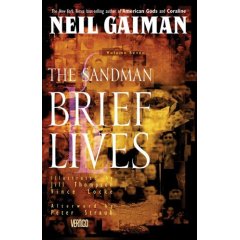
Book Banter -- Brief Lives


Title: Brief Lives (Sandman, Vol. 7)
Author: Neil Gaiman et. al
Length: 256 pages
Genre: graphic novel
Plot Basics: Dream, aka Morpheus, one of the Endless, is visited by his youngest sister, Delirium. Delirium wants to find their brother, Destruction, who hundreds of years earlier, walked away from his post, abdicating his responsibilities. Dream and Delirium undertake a journey to find Destruction and learn how short life really is.
Banter Points: Word Nerd has been slowly reading through the collected volumes of the Sandman comics/graphic novels. This one is by far the best so far. Dream and Delirium are both part of the seven siblings that make up the Endless. The Endless aren't gods, but have always been. But though they have been forever, this volume takes on the idea of the brevity of life, no matter how many years a person has (endless or otherwise). Just because these are graphic novels/comic books, don't overlook the thematic elements of stories like this.
Bummer Points: Somehow, the art just didn't appeal to Word Nerd as much in this volume. She's not enough of a graphic novel fan to know if somebody different drew this volume. But, Dream looked different.
Word Nerd recommendation: These aren't pulp comics (no ker-pows or blams, here), but they aren't illustrated novels either. If you've never ever read a graphic novel, don't knock them until you pick up a Sandman.

06 December 2006

Author Answers with Tanya Lee Stone

This week's author is Tanya Lee Stone, whose first teen fiction book, "A Bad Boy Can be Good for a Girl" has gotten lots of good marks from reviewers. Stone has also written picture books and non-fiction books for kids.

To read an excerpt from "Bad Boy" or to see Stone's other titles or learn more about her, check out her website.

WN: You’ve written picture books and non-fiction for kids, why did you decide to try your hand at teen fiction for “A Bad Boy Can be Good for a Girl”?

STONE: It was a combination of things. I had been primarily writing other kinds of books for kids, as you said. And I felt ready for a change. I wanted to stretch myself, grow in new ways, challenge myself as a writer. I've always loved writing fiction and I wanted to see where it might take me.

WN: "Bad Boy" is written in a free-verse poetry style, yet it tells a story like a novel. How did you decide that format was right for your story?

STONE: The book actually started out as a short story, and the poetry format happened organically. It felt like a natural way to tell Josie's story in the 1st person. When I added the other two girls to make it a complete novel, I quickly discovered that the poetry really allowed me to let the characters speak in their unique natural cadences. Each girl's section even looks slightly different visually as, for example, Nicolette speaks in shorter, more powerful phrases and Aviva's sentences are longer and more-flowing, in keeping with her personality. Poetry was a wonderful way to explore their voices.

WN: What's next for you in the writing world?

STONE: I'm usually working on two or three things, each at various phases. In January, I have a biography of Amelia Earhart coming out. The following year, 2008, there will be a picture book about Elizabeth Cady Stanton called Elizabeth Leads the Way, with wonderful illustrations by Rebecca Gibbon, as well as a Young Adult biography of Ella Fitzgerald. And two other projects are also in the works--another novel and a book for readers 10 and up, about the Mercury 13 women who started NASA training in 1961 before NASA pulled the plug on them. That book is called Almost Astronauts.

WN: What's the best part of being a writer to you? What's the most challenging part of writing for you?

STONE: I love, love, love writing. It's often how I really figure out what I'm thinking about. It's a way of processing the world: you explore issues and questions that are on your mind. The bonus, of course, is getting to go to work in my pajamas! The most challenging part of writing is often finding nice long stretches of uninterrupted time in which to think.

WN: How did you feel when you first saw your name on the cover of a book?

STONE: Oh gosh, we're going back more than 10 years, but I seem to recall feeling pretty giddy.

WN: What is the best/most influential book you have ever read and why did it inspire you?

STONE: I don't think I could pick just one. When I was little, Harold and the Purple Crayon made a big impact on me. Imagine that you can create the life you want simply by drawing it. Oh, the possibilities! In middle school, A Wrinkle in Time was a big book for me. A strong girl, speaking her mind and trusting her instincts. Yes! Books in general were a huge part of my life, and continue to be. So many world views, so many things to learn and think about. I'm a book baby, for sure. My mom is a retired librarian and my dad is a professor and a writer.

WN: What is your favorite word and why?

STONE: I love the word splendiferous. It sounds like what it means, and it makes me smile.

WN: What piece of advice helped you out the most as a writer?

STONE: Someone once told me to give myself permission to write a crummy first draft in order to get the ideas that were percolating in my head down on paper. Excellent advice. There is always time to revise (and revise and revise) to get the words just right!

UPDATE: Stone tonight will be doing a live chat at 7 p.m. EST/6 p.m. CST at Young Adult Books Central in the chat room. Word Nerd was going to post the link, but Blogger is being persnickety, so you may just need to search for it instead. Apologies.