28 September 2006

Two more days and other tales


Voting remains open for another two days on Word Nerd's "What Classic to Read Next" poll. Word Nerd's going to be on another airplane soon and this will likely be one of the books she takes with her. Maybe that figures into your vote... High entertainment value is good.

As before, other suggestions for what book(s) to take on the plane are welcome.

Also --
The revision meter is slowly starting to creep upwards. Word Nerd is finding that it's hard to get in the swing of these changes. She's going to have to put in some effort this weekend to get through the changes on the next 15 pages to make the end of the month goal of being done with the first revisions to the first two chapters. Or maybe she needs to make her chapters shorter...

Also --
Word Nerd's staring at a a mostly blank calendar of Wednesdays for the rest of the year which means she needs authors to interview. A little teaser here -- Mitch Albom will be the featured author next week (Oct. 4) and Word Nerd's got interview requests out to Jim Butcher, Charles de Lint and Nick Bantock. With the number of authors out there, she'll find some to interview, but reader suggestions always take higher priority.

Also --
For the Oshkosh readers, mark your calendars. Author Tate Hallaway will be at Apple Blossom Books (513 N. Main St.) for a book signing of her new book, "Tall, Dark and Dead" from 10:30 a.m. - 12 p.m. on Oct. 7. Word Nerd featured Hallaway in an Author Answers column several weeks ago.

27 September 2006

Author Answers with Mindy Klasky

Mindy Klasky is this week's featured author. She's got a new book out in stores, Girl's Guide to Witchcraft.

WN: You’ve got a new book out…what’s it about and what kind of readers would really like it if they picked it up?
KLASKY: GIRL'S GUIDE TO WITCHCRAFT is a contemporary comedy with fantasy elements. It reads like the intersection of BRIDGET JONES'S DIARY and HARRY POTTER, telling the story of a librarian who discovers that she's a witch.

GIRL'S GUIDE appeals to readers who enjoy escaping the "real world" in their fiction - to readers who say, "I wish I had a magic wand to solve that problem at the office." While I hope that readers of my fantasy novels will join me in this new venture, I'm also hoping to find many new readers.

WN: What new challenges did you face writing “Girl’s Guide to Witchcraft” that were different from writing the Glasswright series or your stand-alone novel, “Seasons of Sacrifice?”
KLASKY: The Glasswright Series and SEASON OF SACRIFICE required extensive world-building, figuring out how things worked in a strange setting unlike our own world.

GIRL'S GUIDE required almost the opposite set of skills -- world-detailing, figuring out the telling details of our real-world existence, so that readers say, "I know *exactly* what she means! That is *precisely* what my life is like!" GIRL'S GUIDE is peppered with references to real world activities and places, which enrich the story and give it realistic depth.

WN: What’s your writing process like from when you first had an idea to getting the novel published?
KLASKY: Every novel that I've completed began with a character, a specific person whose voice entertained me well before I worked out the details of plot. GIRL'S GUIDE was no exception.

After spending a couple of weeks writing notes to myself in a journal, I decided that I knew enough about librarian Jane Madison to start figuring out her plot. I drew up a brief outline (approximately three pages, for a 400-page book), setting it up in a spreadsheet so that I could track page-length and word-count as I wrote.

While I completed some chapters of the novel by working in the mornings, before heading into the office and my "day-job", I wrote most of it on vacations from that "day-job". I took two Writing Marathon breaks for this book -- a week off from work (with weekends attached) so that I had two sets of nine consecutive days to write.

I revise each chapter a few times as I write. Once I've completed my first draft of the entire novel, I read through the manuscript once for substantive errors (e.g., characters' eyes changing color!) and then I read the completed manuscript once, out loud, to make sure that the words flow perfectly.

After that, the manuscript is beamed to my New York editor electronically. While I made a handful of changes in response to my editors' queries, I did not make substantial revisions on GIRL'S GUIDE.

WN: What is your favorite word and why?
KLASKY: My favorite *phrase* is "And then..." To me, this phrase conveys the essence of storytelling -- the hero went walking in his field. And then, adventures happened. And then, he returned home. "And then" is the essence of potential to a storyteller.

When you’re not writing, what do you do (hobbies, career, etc.)?

I work full time as the manager of a large law firm library. In my spare (!) time, I enjoy quilting, cooking, reading (both non-fiction and fiction, in the genres I write, and out of them.) I also relish "get-away" weekends with my husband, particularly to nearby towns rich in history and culture.

WN: What is the best/most influential book you have ever read and why did it inspire you?
KLASKY: For years, my answer to this question was THE LORD OF THE RINGS, because it opened up my mind to the wonder of a fully-realized fantasy world. Lately, though, I've realized that the Deryni novels of Katherine Kurtz, particularly her first trilogy (DERYNI RISING, DERYNI CHECKMATE, and HIGH DERYNI), had a greater influence on my career as a writer. Kurtz's novels are peopled with incredibly realistic characters, people who seem alive and breathing. Those characters first made me realize that *I* could write, that *I* could create stories and share them with friends.

WN: If you got stuck on a desert island with one of your characters, who would you want to be stranded with and why?
KLASKY: Melissa White, the best friend of the main character in GIRL'S GUIDE TO WITCHCRAFT. Not only is Melissa a sane, level-headed person who could provide wisdom and solace on a desert island, but she is a first-class baker who would find some way to create dessert miracles!

WN: What piece of advice helped you out the most as a writer?
KLASKY: "Writers write." I've seen this phrase attributed to many people; I believe that it was actually E.B. White who said it. Even when the story doesn't want to flow, even when the publishing establishment seems to teeter on the edge of solvency, even when the day job looms, writers write. Sitting down and putting words together builds the story. It's really that simple.

26 September 2006

Questions, anyone?

If you haven't heard, author Mitch Albom (Tuesdays with Morrie, The Five People you Meet in Heaven) is going to be in Oshkosh.

And since he's coming here, and since Word Nerd interviews authors, she's going to talk to him.

She's got questions she can ask, but for those who may not be able to go to the reading/signing event with him, if you are dying to ask him something, post it here and Word Nerd may be able to work it into her interview.

25 September 2006

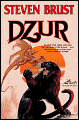
Book Banter -- Dzur


Title: Dzur
Author: Steven Brust
Length: 285 pages
Genre: fantasy
Plot Basics: After being on the run, wise-cracking assassin Vlad Taltos comes back to Adrilankha with a price on his head and a chance to mend some of the relationships there.
Banter Points: This is the 10th book in the Vlad Taltos series and Word Nerd was very excited when she found out this one was being released. Vlad and his familiar Loiosh have such funny banter back and forth throughout the book.
One of the other things that Word Nerd has always liked about this series is that it's not all spelled out. For example, when Vlad has a plan that involves other characters, there'll be a line, like, "I told them my plan and they agreed." It's nice as the reader to not know what's coming until the scene unfolds when they carry out the plan.
Also, this book cleverly follows a meal, with each chapter getting introduced with each new course. Vlad's voice comes through even more clearly in these sections -- example: With cooking and murder, there really shouldne be a "good enough." You need to get as close to perfect as possible, otherwise find another line of work....Another similarity if you will between committing murder and indulging in supreme pleasure: Both take one's full concentration.
Bummer Points: It had been a while since Word Nerd read book 9, so she felt a little foggy during some of the reading about what exactly was happening. The real salient details emerged from her memory though. And... is book 11 on the horizon anywhere?
Word Nerd recommendation: If you are looking for good fantasy, these are a must read. Go back to the beginning of the series, read them in the order that Brust wrote them. (The story's chronological order is different).

22 September 2006

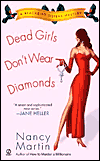
Book Banter -- Dead Girls Don't Wear Diamonds


Title: Dead Girls Don't Wear Diamonds
Author: Nancy Martin
Length: ~250 pages
Genre: mystery/chick lit
Plot Basics: Nora Blackbird, part-time social columnist and impoverished socialite finds herself having to unravel another swanky murder. After she's at one of Philadelphia's glitzy parties, the wife of Nora's old college flame turns up dead in the swimming pool... and the emerald ring from her grandmother that Nora wears turns up missing. Are the two connected? And is Nora under suspicion for murder because of running in to the dead woman's husband at the party?
Banter Points: These Blackbird sister mysteries are a hoot. Nora -- and her sisters Emma and Libby -- are hilarious characters, particularly the very-pregnant Libby in this book. These books have the right mix of high fashion, mystery and romance as Nora tries to figure out her relationship with quasi-crime lord Michael "The Mick" Abruzzo.
Bummer Points: SPOILER: Are Nora and Michael ever going to get together?
Word Nerd recommendation: Do yourself a favor: While waiting for the hold to come in on the latest Evanovich novel, read these, because the time will be well spent.

21 September 2006

What I Learned Reading

Word Nerd spent part of Monday and last Friday on airplanes, but instead of using the time to devour some novels written by other people, she read the rough draft of her own.

She hopes this doesn't sound pretentious, but she learned first -- the rough draft does not completely suck. Not to say that there aren't sections that could use some major, major work, but at least Word Nerd wasn't tempted to chuck the thing out the airplane at 18,000 feet.

Second, she learned that there are some definitive spots that need some work, making some plot transitions, etc.

Third, Word Nerd realized that she didn't really introduce her characters as well as she could. This is one area where she's going to be spending some revising time for sure, helping round out on paper the folks that become the main characters. They are all in her head, but somehow what she knows about them didn't make it all on paper.

So -- the amended goal for the rest of September and writing: Word Nerd's going to work through the first two chapters. She hopes to get farther than that, but since there are only 10 days left in the month she didn't want to be overly ambitious.

20 September 2006

Author Answers with Bob Morris

For you Wisconsin-based readers, this week's featured author might put you in a warmer frame of mind; Bob Morris is the author of the Caribbean mystery series. He's the author of Bahamarama, Jamaica Me Dead and the forthcoming Bermuda Schwartz, which hits shelves in Feb. 2007.

For more about him, check out his website, or his blog.

WN: What’s your writing process like from when you first had an idea to getting the novel published?
MORRIS: I got the idea for my first novel, Bahamarama (and the ensuing Caribbean series) while walking down a beach on Harbour Island in the Bahamas. I went back to my cottage and wrote what became the first chapter. The next day, I flew home and quit my job as editor of Caribbean Travel & Life magazine. My wife, bless her heart, said: “Uh, do you realize we have two kids in college?” But it was one of those now-or-never things. Four months later, Bahamarama was finished. It took me another nine months, and 27 rejections, before I landed an agent, who within a week had three offers for the book, including a three-book deal from St. Martin’s Press. That’s the one I took.

Beyond that, I just go to places like Jamaica (Jamaica Me Dead) or Bermuda (Bermuda Schwartz) or Trinidad (Trinidaddy-O, the book I’m currently working on), soak up everything I possibly can and then figure out new and unusual ways to kill people.

WN: How did you come up with your main character, Zachary Chasteen?
MORRIS: He just started speaking to me while I was walking down that beach on Harbour Island. Maybe I needed to be on medication or something, eh? But I liked his voice and knew he was the guy.

WN: You’ve also worked as a journalist and a food critic and a travel writer, how have these careers influence you as a novelist?
MORRIS: I can’t imagine not having a background as a newspaper reporter, columnist and, later, a magazine editor and travel writer. It has taught me all the important stuff: Persistence, research and the importance of writing something every day.

WN: You write funny, mystery books set on islands not that far from Florida… do you worry about being compared to writers like Carl Hiaasen and is the comparison a bad thing?
MORRIS: Carl’s a friend and is the guy at the top of the heap. I would glorify in any comparison, but our stuff is totally different. There are so many really good mystery writers working Florida – Randy White, James Hall, Jon King, James Born, the list goes on and on and on – that it’s one reason why I decided to set my books in the Caribbean. The turf was getting kinda crowded.

WN: What is the best/most influential book you have ever read and why did it inspire you?
MORRIS: I can never answer this question. I mean, I have read gazillions of books and I always draw a blank when asked this. But like so many of my generation and, I would hope, many generations that follow, I was completely drawn to the voice of Holden Caufield in “Catcher in the Rye.” Sardonic, wry, wise and damaged – it worked on all levels for me.

WN: If you got stuck on a desert island with one of your characters, who would you want to be stranded with and why?
MORRIS: Well, that would definitely be Barbara Pickering, Zack’s lady love. My wife firmly believes that I created Barbara in her form, even though Barbara is brunette, British and a magazine publisher and my wife is none of those things. They are, however, both incredibly beautiful and sexy and constantly alluring so, please, go ahead and strand me.

WN: What piece of advice helped you out the most as a writer?
MORRIS: My mom, after I had flunked out of college and spent two years traveling around the world with no apparent focus to my life, said: “I love you, son, but please do something.”
That was all the fire I needed…

19 September 2006

Avast! It's time to celebrate, me hearties!

Today be Sept. 19th, which means that it's Talk Like A Pirate Day.

You can brush up on your pirate vocabulary and more, here.

There are also links on the site to quizzes and games, such as the pirate name generator.

Word Nerd discovered that were she a pirate, she would be:

Black Morgan Roberts

Like anyone confronted with the harshness of robbery on the high seas, you can be pessimistic at times. Two things complete your pirate persona: style and swagger. Maybe a little too much swagger sometimes -- but who really cares? Arr!

15 September 2006

Book Banter -- The Sorceress and the Cygnet

Title: The Sorceress and the Cygnet
Author: Patricia A. McKillip
Length: 231 pages
Genre: fantasy
Plot Basics: A young Wayfolk man, Corleu, has to become the apprentice of sorceress Nyx Ro in order to save his people and his true love. But in doing so, Corleu awakens characters out of children's rhymes and mythology -- the Gold King, the Blind Lady, the Dancer and more -- and their resurrection threatens the power of Nyx Ro's house and brings her into conflict with her cousin, Meguet.
Banter Points: McKillip's prose is lyrical and haunting.
Bummer Points: It's also confusing. Word Nerd suspects that the confusion is intentional for the plot, but sometimes she wondered if she was really getting what was going on.
Word Nerd recommendation: McKillip was recommended to Word Nerd as a being a fantasy author worth checking out. McKillip's got 10 years worth of back-list, so Word Nerd's going to read another one or two before making a decision.

14 September 2006

The stack on the floor

Word Nerd has an over-abundance of books (even for her) checked out of the library and stacked on her floor right now.

She thinks she'll get through them all. (That's if she doesn't trip over the stack, inflicting some kind of bodily harm before then.)

Here's the current pile:

Sleep Tight, Anne Frasier
Bahamarama, Bob Morris
The Book Thief, Markus Zusak
Dzur, Steven Brust
The Cygnet and the Firebird, Patricia McKillip
All the King's Men, Robert Penn Warren
Destiny, Alex Archer
Dead Girls Don't Wear Diamonds, Nancy Martin
Some Like it Lethal, Nancy Martin
Firestorm, Rachel Caine
The Cinderella Pact, Sarah Strohmeyer

If she tries to go to the library and check anything out again, somebody please stop her.

13 September 2006

Author Answers with Shanna Swendson

Shanna Swendson is this week's featured author.

She's the author of Enchanted, Inc., and Once Upon Stilettos. Her third book in the Enchanted series is due on shelves in April 2007. She's also written some essays in anthologies about topics from Battlestar Galactica to Pride and Prejudice. For more about her, check out her website.

WN: What's your writing process like from when you first had an idea to getting the novel published?
SWENDSON: It sometimes takes a long time for me to go from having an idea to actually writing a book. Usually, there's some spark of "what if" that goes off in my brain, but there's not enough to it to get an entire book out of it. That idea may later bump into another idea fragment in my head, and then if that happens enough times, eventually I've got something I can work with.
In the case of Enchanted, Inc., the initial spark of idea was that I wanted to read something that did for adult life and the corporate world what the Harry Potter series did for school and teen life. I couldn't find anything much like that, so I realized I'd have to write it. Meanwhile, I had this really old idea fragment in my head that had been searching for a story for years. Ever since my first visit to New York, I'd wanted to write a book that was an outsider's perspective -- a Southern belle from a small town taking on the city. Usually stories like that involve the small-town girl being overwhelmed by the city and how tough and mean it is, but my experience had been the opposite. The merest hint of a drawl and I could get anything I wanted there. The book ended up not quite going in that direction, but it did merge the idea of someone working in magic with my old small-town girl in New York story.
Once I have the basics of the idea, I do more focused brainstorming about what will happen in the plot, what kind of characters there might be, what problems the main character will have, what ideas and themes I want to deal with. I do some research into any specific subject matter I want to address (for these books, I read books on the business world, office politics and dealing with difficult co-workers) and visit the locations. After I have all that, I outline the plot and start writing.
With that first book, I wrote a full manuscript before I started looking for an agent. Now that I have an agent and publisher, I generally write three chapters and a synopsis, then when the publisher makes an offer and we go to contract on it, I write the rest of the book. I go through two major drafts, with some minor revisions in in-between drafts along the way. Usually I write the whole book, tinker with it a while, and then my agent tells me what's wrong with it, so I then go and rewrite a lot of it, then tinker some more before turning it in.

WN: Your Enchanted, Inc., novels are largely fairy tales - what's appealing about fairy tales to grown-up readers?
SWENDSON: I think a lot of adults -- particularly those who enjoy reading fiction -- have never really lost that child-like sense of wonder that makes them want to believe in extraordinary things. Meanwhile, as adults we know how tough the world really is, so it's nice to escape for a little while to a place where you can get what you want with the wave of a hand. I do have a little fun spoofing some fairy-tale conventions (in the third book in the series, I take on fairy godmothers), so I'm putting my own twist on fairy tales. I like playing with the idea of how some of these fairy tale things I sometimes catch myself wishing for would really work in real life.

WN: You've also written some essays on topics from Battlestar Galactica to Desperate Housewives... what are you discovering about pop culture from looking at these shows with a critical eye?
SWENDSON: The sad thing is that I've always looked at pop culture with a critical eye. I spend way too much time on Internet message boards dissecting TV series, analyzing their plot elements and themes, figuring out which archetypes the characters fit, and stuff like that (I really need a life). I do all kinds of literary analysis on TV and movies, just for fun. I somehow managed to luck into a situation where people are willing to pay me to do that. It's kind of cool to be able to start considering your hobbies -- the things you'd be doing anyway -- as a valid part of the workday. When I started working on the Battlestar Galactica essay, I'd jokingly moan, "I have to go to work now," as an episode came on, although I was actually eagerly anticipating it.

WN: What is your favorite word and why?
SWENDSON: I can't think of any particular word that sends me into raptures. If you ask the copy editors who work on my books, they'd probably say my favorite word is "just." I do a global search for "just" in every manuscript and eliminate it except where absolutely necessary, and the copy editor can still usually find it four times in a single paragraph.

WN: What is the best/most influential book you have ever read and why did it inspire you?
SWENDSON: That's another impossible question! When you read as much as I do, it's hard for any one book to have that much impact. It's more of a cumulative thing.
I'm also terribly fickle. Something may really set me off for a while, until I find the next thing.
If I absolutely have to choose something, it would probably be The Chronicles of Narnia by CS Lewis (or if I can't choose the whole series, The Silver Chair, since that's the first one I read). That series really sparked something in my imagination and made me want to tell stories like that. I read those when I was in sixth grade, and it was like someone flipped a switch in my head that turned me into an aspiring novelist. The books themselves weren't necessarily inspiring or life-changing in and of themselves, but the experience of reading them really did something to me, so I guess you could say they were life-changing.

WN: If you got stuck on a desert island with one of your characters, who would you want to be stranded with and why?
SWENDSON: Owen Palmer, from my Enchanted series. He's a super-powerful wizard, so he'd be very handy to have around. Plus, he's very cute and quite nice, so he'd be pleasant company. With a lot of uninterrupted time together, I might even be able to eventually figure out exactly what makes him tick.

WN: What piece of advice helped you out the most as a writer?
SWENDSON: I know I should probably say something inspirational about never giving up or writing from the heart, or something like that, but the most helpful advice I've ever had as a writer was to make a list of twenty things when you're brainstorming a book, a chapter, a scene, or whatever. There's something about pushing yourself to go all the way to twenty that forces you to be creative. I've found that the first five things I come up with are the things that have to happen to keep the story moving, and the last five are the things that really make the scene come to life. That's become an essential part of my writing process, and it's a sure cure for writer's block.

12 September 2006

Book Banter -- Looking for Rachel Wallace

Title: Looking for Rachel Wallace
Author: Robert B. Parker
Length: 219 pages
Genre: mystery
Plot Basics: Spenser is hired by a publishing house to be a bodyguard for Rachel Wallace, a radical feminist author. Spenser's machismo doesn't sit well with Rachel and after just a few days on the job, she fires him. But when Rachel is kidnapped, Spenser takes it upon himself to find her.
Banter Points: This one was interesting -- the interplay between Spenser and Rachel was well-written at the beginning. Spenser has been described as the "thinking man's detective" and that fits well with what we saw of him in this book.
Bummer Points: Spenser again, solves the crime partly with violence. This is the key difference Word Nerd is seeing between mystery series with male detectives and female detectives -- the women throw fewer punches.

Word Nerd recommendation: Word Nerd enjoyed this one better than Judas Goat, the last Spenser novel she read. She's going to keep chipping away at the series in the future, but this 30-year backlist will take awhile to get through.

11 September 2006

A new OED

No... not that OED (Oxford English Dictionary)

Try the Omnificent English Dictionary in Limerick Form.

So far, this new tome only goes up through words beginning with Cd, but it's growing. It's probably not the best tool if you're trying to prep for the SAT vocabulary section. It is, however, quite humorous.

A few example, just for kicks.
Buckeye:
The buckeye's a tree, but oh my, oh,
The word's also used (don't know why, oh)
For the folks who ain't roamin'
But makin' their home in
The beautiful state of Ohio.
(--SheilaB)

accompanist:
Like the Captain and Toni Tennille,
Kept together by love that they feel,
An accompanist plays
So the vocalist stays
With the music, in phase and on keel.
(--Chris Doyle)

08 September 2006

Book Banter -- Enchanted, Inc.

Title: Enchanted, Inc.
Author: Shanna Swendson
Length: 308 pages
Genre: paranormal chick-lit
Plot Basics: Katie Chandler has always seen strange things in New York City -- like the girl with fairy wings on the subway -- ever since moving there from her small hometown in Texas. She's chalked it all up to it being in the big city. But when Katie pursues a new job to get out of the miserable office she currently works in, she learns that there's a good reason for why she's seeing the strange things. It's all real, fairies, magic and the like and Katie has talents the magical business world desperately needs.

Banter Points: If you've never read a paranormal chick lit book this may be the best entry-level book ever. Though it's premise is largely the same as Harry Potter -- there's a magical world going on right under the noses of the non-magical community -- the plot is so different from the boy wizard's. Katie is a great protagonist and Swendson peppers her paranormal New York with great little details. For a newbie reader though, the magical elements aren't jarring. It's, in essence, a fairy tale about a girl discovering a magical world and hoping for a handsome prince.
Bummer Points: SPOILER ALERT......

Chick lit has that element of a love story in it somewhere. For the whole book, Katie's crushing on Owen, a hot, albeit shy, wizard in Research and Development. And nothing remotely romantic happens between them.

Word Nerd recommendation: Word Nerd was definitely enchanted by Enchanted, Inc. The sequel, Once Upon Stilettos, is on her list of books to read.

BONUS: Tune in Tuesday when Word Nerd's next Author Answers interview is with Shanna Swendson!

07 September 2006

Breaking out the red pens*


*And the purple and the green ones too.

Word Nerd is gearing up for some editing. That's right. Her novel.

Word Nerd has a trip on an airplane coming up and she's planning to use the confined time to read, only this time, instead of reading somebody's else, she's going to read her own.

It's been a couple weeks now since she finished the rough draft. In the interim, it's been sitting in a 3-ring binder on a shelf. Word Nerd feels only slight twinges of guilt for this.

Revision has always been one of the steps in the writing process. Word Nerd thinks "waiting time" should be one too. Maybe weeks is on the side of "vacation" rather than "waiting time," but the purpose is the same -- to come back to the manuscript with fresh eyes.

Think about it. No matter what writing it is, you (as the writer) are engrossed in it while you're writing it. In Word Nerd's case, that was 6 months of spending lots of quality time with Ainsley Doran (her protagonist), Westin Mackay (Ainsley's new squeeze), Gilles Brossard (a French inspector), Ibsen Volkart (the bad guy) and others. Not "seeing" them for a few weeks will hopefully make problems in the story stand out more clearly. Word Nerd knows the problems are there, but not being steeped in the story every day should help new solutions present themselves.

Getting through the manuscript once is part of Word Nerd's writing goal for September. After that, a revised goal for the rest of the month will be figured out.

06 September 2006

Author Answers with Diana Peterfreund

This week's author is debut novelist Diana Peterfreund.

Peterfreund's got a background that ranges from geology to food criticism but became a full time novelist this year. Her first book, Secret Society Girl, was published in July. For more about her, check out her website or her blog.

WN: What's your writing process like from when you first got an idea to getting the novel published?
PETERFREUND: When I get an idea for a book, I let it marinate in my brain for a few weeks/months/years -- however long it takes. When I have a firm idea of my story, I write out a synopsis in loose paragraph form, outlining the major plot developments, character arcs, etc. Then I begin writing. I usually write several chapters before I tell anyone about the book, just to make sure that it doesn't fall apart once it's on the page.
In the case of Secret Society Girl, soon after I told my critique partner about the book, she pitched it to an editor at a writing conference. This editor requested it, as did a few agents. I sent out what I had (about three chapters) and secured an agent, who shopped it to publishers for me. We sold it a week and a half later at auction (which means that more than one publisher bid on the manuscript) to Bantam Dell. Four months later, I finished the manuscript, and then it went through the usual hoops: revision, editing, copyedits, proofreading, etc. It hit the shelves in July of 2006, about 18 months after I got the original idea.


WN: The young adult market has been really hot for a while now, what's the draw as a writer to that market?
PETERFREUND: Sadly, I think one of the major draws at the moment is exactly what you said: that it's really hot. This kind of trend jumping is really insidious and leads to some sub-par books being published. Personally, I think writing for children is harder than writing for adults. They've read fewer books so every book is going to be a significantly more seminal experience for them. Almost all of my favorite books are book I read when I was young. If I were to write for the young adult market (which I haven't yet), that would be the draw for me: to write the books that some other adolescent will years later remember as one of her favorites.

WN: What kind of research did you do for Secret Society Girl?
PETERFREUND: To start with, I went to Yale, where I learned most of it during four years of experiences I'd tell you about in detail, but then I'd probably have to kill you. And then, I filled in the blanks by reading history books, newspaper articles, etc. It's a little-known fact that most secsocietiesties just crib their traditions off of one another. I've had members of different societies come up to me and demand to know who told me such and such, only to get very embarrassed when they learn where I really derived that bit of info from (or worse yet, that I simply made it up!).

WN: How did your experience in other careers help you as a writer?
PETERFREUND: Before I was a novelist, I was a journalist, I think journalism helps you write to deadline, stay on topic, write clearly, and write to length. Because the restrictions in newspaper columns leave little room for waxing poetic, you learn what part of your deathless prose can be killed off if necessary.

WN: What is the best/most influential book you have ever read and why did it inspire you?
PETERFREUND: I can't imagine picking just one, unless I could remember the first book I read, because it laid the groundwork for all the others. There are so many books that I adore and read over and over. One of my favorite novels is The Count of Monte Cristo, by Alexandre Dumas. It's a wonderful, kitchen sink of a popular novel. Anything you could possibly want in a book: adventure, romance, intrigue, revenge, imprisonment, vampires, serial killers, pirates, hidden treasure, mystery, sex, drugs, masques... if you've only seen the movie or only read an abridged version, do yourself a favor and read the whole thing (The Robin Buss translation, published by Penguin Classics, is fantastic). I love it because it's a thousand pages long and a complete page turner every step of the way. Despite the complexity of the plot and the enormous character list, everything ties together at the end. I love the idea of this master storyteller that you can trust to take you on an amazing adventure.

WN: If you had to live the life of one of your characters, who would you pick and why?
PETERFREUND: Ooh, tough question. Probably whatever character ends up with Brandon, because I'm a little bit in love with him. He's such an incredible guy and I bet he'd be a great boyfriend/husband/father/etc. Plus he's smart, funny, cute, and dorky. I like that in my guys.


WN: What piece of advice helped you out the most as a writer?

PETERFREUND: "Writers write." That advice has to come before everything else. You can't be a writer without doing it, and you can't continue to be a writer unless you make a habit of doing it. Too many people say they want to be writers but don't actually write. If you really, really want to be a writer, you write. Period. Once you have that bit of advice down, you're 90% there. The other 10% is hard, don't get me wrong, but nothing to that first step. Once you are writing, the best piece of advice is from Elmore Leonard: "Leave out the parts people skip."

05 September 2006

I want my AAC*

*(Author Answers Column)

The Author Answers column will now be appearing on Wednesdays.

The change is due to Word Nerd's real job and wanting to make sure the Author Answers columns get the post time they deserve.

Also -- she is still (and always) looking for suggestions for authors to interview. Nominations are now open.

Double Edition Book Banter -- Dragons of Winter Night/Spring Dawning

Title(s): Dragons of Winter Night & Dragons of Spring Dawning
Authors: Margaret Weis and Tracy Hickman
Genre: Fantasy
Length(s): 339/342 pages
Plot Basics: After one victory at Thorbardin, the companions find themselves separated and caught up in the war even more as they pursue the dragon orbs. In traveling to Silvanesti, home of a race of elves, they all share a frightening dream of the future. It's the frail wizard Raistlin who saves the others there by making a mysterious and powerful bargain.
The companions and the Dragon Highlords race against each other to find the Green Gemstone Man -- the one who is key to ending the war. The companions find that one of the Dragon Highlords seems awfully familiar...
Banter Points: High action, high fantasy... These books really do read a lot like a role-playing game session.
Bummer Points: The character development is a bit lacking. The stories are more about what happens to the characters and so things that could be more poignant in the characters' own development are a bit short-changed.
Word Nerd recommendation: If you like the genre, these are worth reading.

01 September 2006

August Bibliometer

For spending the first half of August finishing her novel, Word Nerd managed to get a hefty amount of reading in during the month as well.

Bibliometer reading:

9 books (YTD, 63)
2,949 pages (YTD, 20,754)
average of 95 pages/day

The books were:
The Judas Goat, Robert B. Parker
Pale Immortal, Anne Frasier
How to Murder a Millionaire, Nancy Martin
Charmed Thirds, Megan McCafferty
Eleven on Top, Janet Evanovich
The Princess Bride, William Goldman
Taliesin, Stephan R. Lawhead
Dragons of Autumn Twilight, Margaret Weis & Tracy Hickman
Dragons of Winter Night, Margaret Weis & Tracy Hickman

31 August 2006

Decisions, decisions

It's high time that Word Nerd read another classic.*

She's turning again to her faithful readers for input on which one. See that poll over there ---->
That's for input. Go vote. Consider it practice for the November elections.

Word Nerd must say, though, she wonders a bit why she chose to do this poll again. Last time she got stuck reading The Count of Monte Cristo (here's a teaser for next week's Author Answers... the featured author likes the Count and gives a pretty good defense of why it's good...)

Honestly, last time on the poll Word Nerd really put the Count on there as a last choice because she didn't take enough time to think through her choices. This time, all the books are ones she thinks she should and wants to read someday. Good for you, as her faithful readers, knowing this time your choice won't lead to angry muttering or thoughts of fudging the democratic process.

The poll is open until Sept. 30. You get one vote.

(*Classic here generally means any book written more than 50 years ago that now gets taught in schools or has impacted the genre or has some enduring literary merit.)

30 August 2006

Cold Feet

Word Nerd realized last night that all the fantasy series books sitting on her floor at home in the to-be-read stack had original publication dates in the 1980s. She has also read all the books in this stack once before.

Though Word Nerd has been reading much chick lit and many mysteries lately, her first love in reading in still sci-fi/fantasy (heavy on the fantasy). But she's finding herself drawn back to these older titles because, well, she's nervous about making a new commitment.

Why this trepidation for the genre she loves, you ask? Two words: Robert Jordan.

Now before you start hurling those 1,000 page tomes at Word Nerd, let her explain. When Word Nerd first started reading Jordan, only books 1-6 or so were available. At that time, Word Nerd and a good friend also reading the series would spend lunch time at high school dissecting and analyzing the plot. And somewhere in there, Word Nerd got frustrated because things stopped happening quickly enough for her in the plot. (And her arms got tired of lugging the 800+ page paperbacks around with her). Jordan, for those of you unfamiliar with this series is now on book 11 of the series and has written at least one prequel as well.

So when Word Nerd wanders through the stacks looking at fantasy series and sees six, seven, eleven some books in a series, she is cautious about picking up the first one and plunging in. Picking up the old standbys are safe, comfortable. She knows the characters, knows the worlds, and knows the series will end... something many Jordan readers are unsure of yet today.

She's not sure she could stand the disappointment of another Jordan series. If the first few pages of a series are a prophecy in the form of the prologue (anything involving wind sweeping over the world or somesuch) she's apt to put the book back on the shelf immediately.

But Word Nerd still wants to read in the fantasy genre.

She's asking for your help. What series are worth it? And why (without giving away too much plot...)

Since she's looking for series she's hasn't read already, here's a partial list of what series she has tackled:
J.R.R. Tolkein: Lord of the Rings
C.S. Lewis: Chronicles of Narnia; Space Trilogy
Robin Hobb: Assassin Trilogy; Liveship Trilogy; Tawny Man Trilogy
Sara Douglass: Wayfarer Redemption (bks 1-3)
Terry Pratchett: Discworld
Margaret Weis/Tracy Hickman: Deathgate Cycle; Dragonlance Chronicles
Anne McCaffery: Dragonriders of Pern
George R.R. Martin: Song of Ice and Fire
Steven Brust: Vlad Taltos series
Stephen Donaldson: Chronicles of Thomas Covenant
Terry Brooks: Shannara books (some of the early ones); Landover; Word and Void series

29 August 2006

Author Answers with Janet Evanovich

As promised a few weeks ago, this week's author is Janet Evanovich.

Evanovich is the author of the Stephanie Plum series (One for the Money, Two for the Dough, etc.) The Plum series, now on book 12, routinely is in the best-seller lists. She also runs a contest on her website where readers can submit ideas for the title of the next book. The current contest for book 13 is open through this Thursday so put on those thinking caps.

To read Evanovich's biography, click here, to go to her website. She has an interesting story that she tells so well, it's silly for Word Nerd to try to recap it all here.

WN: How has your writing process changed from when you started writing serial romances to having the Stephanie Plum books top best-seller lists?
EVANOVICH: The process hasn't changed much but the amount of time spent at the computer has increased dramatically. Plus I now spend time answering fan mail, touring, and interacting with the media.

WN: What piece of advice helped you out the most as a writer?
EVANOVICH: Never hold anything back for the next book.

WN: What is the best/most influential book you have ever read and why did it inspire you?
EVANOVICH: Uncle Scrooge in Back to the Klondike. It gave me a life-long love of the adventure story.

WN: Why did you decide to have contests for readers to title the next book? does the winning title influence the story at all?
EVANOVICH: I suck at thinking up titles so a bunch of years ago we decided to hold a contest and let the fans help out. The winning title never influences the book. We just like something that's catchy and has the appropriate number.

WN: How did you feel the first time you saw your name on the cover of a book?
EVANOVICH: I was really excited. I got a couple covers and framed them and gave one to my mom and dad and put one in my office.

WN: Do readers need to worry about the Stephanie Plum series ending?
EVANOVICH: No plans to end the series anytime soon. I'm having fun.

WN: Stephanie ends up in some wacky predicaments... do you worry as a writer that it's too over the top or how do you make sure that readers will believe the crazy circumstances she lands in?
EVANOVICH: I worry about EVERYTHING. There's a technique in writing called "suspension of disbelief" and it's my best friend.

WN: What kind of research have you done throughout writing the Stephanie Plum series?
EVANOVICH: I learned to shoot and I hung out with bounty hunters and cops. I also ate a lot of doughnuts and drank a lot of beer.

WN: What's your favorite word and why?
EVANOVICH: My favorite words probably couldn't be printed here! Hey, I'm from Jersey!!

WN: What's one question a reporter has never asked you before (and the answer to that question)?
EVANOVICH: Would I accept ten pounds of Godiva in payment for the interview. And the answer would be yes.

(Word Nerd note: No Godiva chocolate was remitted for this interview).

28 August 2006

Book Banter -- Dragons of Autumn Twilight


Title: Dragons of Autumn Twilight (Dragonlance Chronicles, bk. 1)
Author: Margaret Weis and Tracy Hickman
Length: 369 pages
Genre: fantasy
Plot Basics: Tanis Half-Elven and his friends made a promise five years ago to go follow rumors of evil in the world and take care of it and meet up again after that timespan passed. On the night of their reunion, all but one of the eight companions comes back. The companions are worried what it means that one of their number chose not to come back, but they don't have long to think about it because they are suddenly plunged into an adventure spanning the continent and charting the future of the world as dragons are suddenly in the skies again.
Banter Points: After Word Nerd did the interview with Margaret Weis a few weeks ago, it got her thinking about the original books in the Dragonlance series. Word Nerd read these when she was a kid and decided to go back and read them again.
Bummer Points: Sometimes going back to the books Word Nerd loved as a kid can be mildly disappointing. She still likes the series, but there are minor things now that she notices... plot leaps, the sometimes cardboardness of the characters that she didn't know to look for when she was younger.

Word Nerd recommendation: If you like hack-n-slash type fantasy, these still are great books. These characters are iconic in the genre, perhaps just a rung or two below Tolkein's characters. The books may not be the most polished piece of writing that you'll ever read, but they are fun.

25 August 2006

What Word Nerd should write this weekend*


* or, How You too Can Enter a Flash Fiction contest.

Jason Evans over at Clarity of Night is holding another flash fiction contest. This time, he's got USAToday best selling author Anne Frasier in on the action and signing copies of her new book, Pale Immortal, as part of the prizes up for grabs.

So. How to enter, you ask?

Write 250 words, any style, any genre, inspired by this photograph. Before 11 p.m. Eastern time on August 29, email your entry to jevanswriter at yahoo dot com.

To see entries that have come in, the full list of what you can win and a fun interview with Anne, click here.

24 August 2006

Move over Batman

Remember when the 9/11 Commission Report came out... it was featured in book store displays and actually made it into the best seller list in 2004.

It was also 600 pages, which is daunting enough when it's a good novel and overwhelming to many readers when staring down that many pages of technical government writing.

But now there's a new way to read the report in a fraction of the original pages and with pictures.

Long time comic book artists Sid Jacobson and Ernie Colon have created "The 9/11 Report: A Graphic Adaptation." That's right: it's like a 9/11 report comic book

The comic book, news stories like this one in the Washington Post about it say, distills the whole report into about 100 pages and has some useful elements like timelines of the days events that give parallel details about the different hijacked planes and the order of happening that morning.

But it's a comic book (ok, graphic novel) and that means in telling the story of what happened, when planes hit the buildings, the panels are filled with words like "Whooom." Some critics are, of course, saying that perhaps "whooom" is too flippant for planes flying into buildings.

Word Nerd doesn't want to level any opinion about that, but she's glad to see the Oshkosh library has a copy of the graphic novel version or order so she (and other readers) can check it out for themselves.

23 August 2006

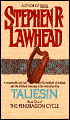
Book Banter -- Taliesin


After Word Nerd finished rereading "The Princess Bride" it got her thinking about other books she read the first time when she was younger and sent her on a hunt for some of those titles again.

The first one worthwhile to pick up again, Stephen R. Lawhead's Taliesin. This is the first book in Lawhead's Pendragon Cycle, his six-book King Arthur series.

Word Nerd, if you're just joining the program, really loves the King Arthur story. It's probably Lawhead's books that sparked the interest. His version of the legend combines the diminishing presence of Rome in Britain with the fall of Atlantis and the spread of Christianity throughout Britain.

Lawhead, like Jack Whyte in his Camulod Chronicles, starts Arthur's story well before Arthur is ever born. But where Whyte's stories are heavy on history, Lawhead's are heavy on spirituality and magic. Taliesin chronicles the life of Charis, a princess from Atlantis and Taliesin the greatest bard Britain has thus far known.

Both Charis and Taliesin are driven from their homelands and into southern Britain (what would now be like Cornwall and Wales). There, they encounter each other and meet up with priests who tell them about the True God. They are both challenged about whether they can believe in this God and how he relates to Taliesin's vision of the Kingdom of Summer. But dark circumstances make the coming of summer seem shaky...


Title: Taliesin
Author: Stephen R. Lawhead
Genre: Fantasy
Pages: ~450
Recommendation: If you like King Arthur, this is a good series. Lawhead doesn't disguise his own beliefs in God and as his characters encounter God, there's a straight-up dose of Christian theology. The series gets better too as it goes on.

22 August 2006

Author Answers with Alison Pace

Alison Pace is this week's author.
She has written "If Andy Warhol Had a Girlfriend" and "Pug Hill." According to her biography, she calls New York City home and doesn't own a pug herself.

For more about Pace, check out her website or her blog.

WN: How did you become a writer?
PACE: I always felt that I was meant to be a writer. It was always my favorite way to spend time for as far back as I can remember. After working in the art world for about ten years, all the while thinking that what I really should be doing was writing my novel, I finally sat down and started it.

WN: How has your background in art helped you as a writer?
PACE: I think the background in art has helped me a lot. For starters it gave me a lot of material for my first novel. Additionally, studying art and writing about it teaches you to look at things very carefully and to notice all the details. For me, that is such an important part, the most important part, of writing fiction, too.

WN: What’s your writing process like?
PACE: I write mostly during the day. The best way for me is to try to stay at my desk on as close to a nine-to-five schedule as possible. While I'm actually writing a novel, I do tend to jump all over the story and write different sections in a way that is not very linear at all.

WN: What’s the hardest part of writing for you (dialogue, descriptions, etc.?)
PACE: I think the hardest part for me is getting everything else that is going on in life out of my head and sitting down and focusing on the writing, without being tempted by distractions. My characters tend to think more than they speak so I used to struggle more with dialogue, but I think I'm getting better at it. I hope so.

WN: Who is/are your favorite author(s)?
PACE: I love Pam Houston, Elinor Lipman, Ann Patchett, Kate Atkinson, Nick Hornby. I just finished Molly O'Neill's memoir Mostly True, which I thought was wonderful.

WN: How did you feel when you first saw your name on the cover of a book?
PACE: It was a wonderful feeling, a tremendous sense of accomplishment.

WN: If you had to live the life of own of your characters, who would it be and why?
PACE: I would love to be Jane Laine in the second half of If Andy Warhol Had a Girlfriend. She got to go to so many wonderful places, and she had the most lovely travel companion, too.

21 August 2006

And the winning number is....

...82,090.

Yes, novel-fans, 82,090 words is the grand total for the first rough draft of Word Nerd's novel.

That's shorter yes than her targeted 85,000 but close enough that she feels that her original target was a good prediction of how long it would take to tell the story. As revisions occur, the word count will fluctuate anyway. Likely up... the more Word Nerd thinks about it, it's likely little things she'll need to add. And with her penchant for leaving out little words like "up" or "for" while she types there are probably another 100 words right there when she adds all those in.

So, if you're asking when will you be able to read Word Nerd's novel, well, the answer is maybe. Someday. There's quite a bit of work that has to happen yet. Word Nerd's taking at least a week off before starting revisions. Then, if she decides to send it out, an agent has to like it also. And then if there's an agent that likes it, then a publishing house has to like it and then it may end up on the shelf of a bookstore near you. There's also the very real possibility that as Word Nerd works through revisions, it will become obvious that this particular manuscript doesn't have enough merit to make sending it out worthwhile.

Sometimes, the things that Word Nerd writes are just for practice. That may even mean a whole novel.

But practice or no, the rough draft is still done.

19 August 2006

Watch the meter go...

Word Nerd hit a good stride again Friday night.
2,000 more words down.
Saturday afternoon may prove to be the point of no return where she has to keep writing until finished. It was close to agonizing to leave the story where it sits currently. But it's a great thing to leave a scene unfinished because it makes starting again easier.

Here's the current word count:

'Zokutou'Zokutou
76,800 / 85,000
(90.4%)

18 August 2006

One down, three days of major writing to go

Ok.
Here's the start of the big wordcountdown. After writing last night, here's the total:

Zokutou word meterZokutou word meter
74,200 / 85,000
(87.3%)


Word Nerd's goal for last night was 1,500 new words. This represents about 2,100 new words.

Also, Word Nerd needs to start extending thanks to the makers of M&M candies for putting dark chocolate M&Ms back on the shelf after Word Nerd was resigning herself to believe they were solely a promotional thing for the release of Star Wars III. Undoubtedly, a large chunk of the end of this novel will be fueled by popping these candy-coated dark chocolates which melt in your mouth, not in your hand, a good thing while typing.

If Word Nerd can, she'll update the word count total throughout the weekend.

But she may be busy writing.

17 August 2006

Thus the End Begins*


*(or, Talking 'Bout my Hibernation... that sounds much less ominous)

Look at the Work-in-Progress word meter over there --->
Yes. It says 72,527. 85 percent.

Hopefully, Monday when Word Nerd blogs, she will be able to update the meter to be filled all the way in. 100 percent.

Cuz this weekend's it. The Four Days in Which Word Nerd Will Finish Writing the Rough Draft of her Novel. (sounds more important when it's all capitalized).

Starting today, Word Nerd's goal is pound out the last 10-12K words by Monday. The plot is at the point (hopefully) where a reader would be hard pressed to put the book down. That's also sort of happening to Word Nerd as a writer. It's hard at this point to stop working on it because the storyline's coming together, there's tension, action, and resolution.

But writing takes time. So Word Nerd's hibernating this weekend. Ringer on the phone off. Nothing else on the weekend docket except writing, writing and um, oh, more writing.

Word Nerd's writing plan looks a little like this:
Thursday: 1,500 words
Friday: 2,000 words
Saturday: 3,000- 4,000 words
Sunday: however many words it takes to get done.

(Thanks to the Hudson, Ohio library for the hibernation graphic.)

16 August 2006

Book Banter -- The Princess Bride


Yes. It was a book before it was a movie.

Word Nerd first read the book of Princess Bride when she was in, oh, probably middle school. As a kid (ok, now, still) she's a fan of the movie. The characters in the book are all the actors in the movie at least in Word Nerd's brain. But first time through the book, Word Nerd didn't like it because author William Goldman kept interrupting.

This time, those interruptions brought some of the best laughs in the book.

Goldman, for those of you unfamiliar with the book version, claims that he's abridging The Princess Bride from S. Morgenstern's version, cutting out Morgenstern's boring parts about politics and history and leaving "the good parts version" of the story with all the fencing, fighting, torture, revenge, chases, escapes, true love (err... sorry, channeling the movie there).

From time to time in the book, Goldman breaks into the story talking about discussions with his editors on what to cut or recollections from his childhood when his dad was reading him what he's trying to recreate in the "good parts version." These interjections are clearly the basis in the movie for the dialogue between the grandfather and the kid. But in the book, they are hysterical (at least to Word Nerd) because several of them poke fun at exactly what frustrates Word Nerd about reading all the old classics (who cares about the queen packing and unpacking all her hats!... get on with it!)

While the interjections are funny, it's really the Princess Bride story itself that's so enchanting. It's a fairy tale, but with a great point: Life isn't fair. The bad guys, sometimes, get away. True love doesn't necessarily triumph.

Word Nerd picked up Princess Bride this time around because it felt unfair to read another chick lit mystery right after reading Janet Evanovich... the other book just couldn't get a fair shake following her. What she found was a book that's going to take a place among the others that she regularly rereads because of its comedy and humanity.

Title: The Princess Bride
Author: William Goldman
Length: 398 pages (including the first chapter of the long-lost sequel, "Buttercup's Baby")
Genre: Fantasy/comedy

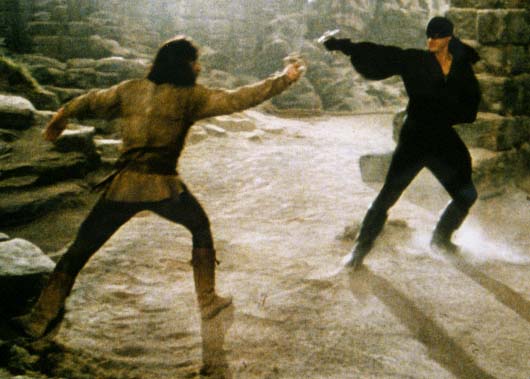
Screencaps from the movie.

15 August 2006

Author Answers with Dave Case

The author spotlight is shining this week on debut novelist Dave Case. Case is a native mid-westerner and the author of the Out of Cabrini, the first Stacey Macbeth mystery novel.

Macbeth is a Chicago cop, something Case knows well. Case spent time working with the Chicago police department as a uniformed cop, in a plain clothes tactical team and Special Operations Section. He's worked SWAT teams and as a sniper and now works in the Education and Training Division of the Police Academy.

Word Nerd: What’s your writing process like from when you get an idea to when it gets published?
CASE: Once I have a number of kernels of ideas to fit together as a story I try and work out the basics of the plot out on a legal pad. This might entail a significant number of pages and eventually leads to a series of index cards that essentially turn into chapters. I find the index cards are more convenient to shuffle around as I try and piece the story together to achieve its most dramatic sequence.
Once I have the plot ironed out it is a matter of writing the story. I find that is the most enjoyable part of the whole process. There are some changes as the manuscript is completed, but for the most part I stay relatively close to the index cards.
Then there is the less-than-enjoyable editing and rewrite portion. My experience with the publishing end was painless and less significant than what I was prepared for. I attribute that to the fact that my novel had been polished for nearly eight years and had been picked over by quite a few very talented people, in my opinion there wasn't much to do.

WN: How did you make the transition from being a beat cop to being a writer?
CASE: That's easy. I sat down and started writing. I don't want to sound ignorant, but it was perfectly natural for me. I studied Studio Art in college, so I do have a creative side and I think that is why it was natural. But as a police officer I write everyday, and as a beat cop my reports essentially tell a story.

What did take a while to evolve was my delivery. I was told by a number of people in my writer's group that I wrote "like a cop," meaning, I think, that I was too matter of fact. I even find myself struggling with that very issue today, probably a result of doing so much writing for my real job.

WN: How realistic of a Chicago cop is Stacey Macbeth… do some things change from how it is in real-life to work in the novel?
CASE: I really wanted my narrative to describe "real" life on the street, both for my cops as well as for my bad guys. In my opinion, since I profess to be a police officer I establish what I like to call an "expectation of authenticity" in relation to my police procedure. I want to extend that to everything I write about though, including but not limited to: life in the projects, the City of Chicago, life as a Chicago Cop, both on-duty and off-duty, really just about everything I address.
Having said that, my work with John Camp (AKA John Sandford) left me with this piece of wisdom among others; "Don't let realism get in the way of my fiction," meaning not to get so wrapped up with depicting something realistic that it detracts from the narrative of the story. That could apply to a procedure, to an action or even an investigative technique. I try and weigh everything with that advise in mind, asking; How does the story move with this procedure? Would it work better some other way? Can I cut a corner and improve the flow of the story?
I also feel that if you know the rules you can usually engineer a way around whatever problem you've encountered. I like to refer to that as "motivational engineering." An example of that would be in Out of Cabrini I wanted Macbeth (Protagonist) to pursue Boo (antagonist) alone, without a radio. A police officer wouldn't do that, so I had to engineer a way for it to happen. My solution was a brief shoot out that resulted in a traffic accident and a police officer shot. Macbeth was struck by the car and lost his radio. But he kept pursuing Boo and didn't discover the missing radio until later. The other officers at the scene were worried about the wounded officer and didn't notice that Macbeth was gone chasing the escaping shooter.
To answer the question more definitely, Out of Cabrini is as realistic as I could make it and I think it does a pretty good job of depicting life on both sides of the law.

WN: How did you know that “Out of Cabrini” was going to start a series? Was that your goal when you started?
CASE: Absolutely, it was definitely my goal to start a series with Out of Cabrini. Macbeth and his whole team will hopefully continue to return with stories from Chicago for awhile. I have a whole bunch of stories to tell.

WN: What is the best/most influential book you have ever read and why did it inspire you?
CASE: There is no conceivable way I could ever determine any one single book that inspired me or even influenced me, but I can tell you about a significant few. As I wrote Out of Cabrini initially I read through John Sandford's "Prey" series. I love his pacing and wanted to try and emulate his style as much as I could. I was hoping to learn subconsciously as I read and wrote.
Sandford turned me on to Stephen Hunter, specifically Dirty White Boys that really struck a cord with me. The opening paragraph is incredible.
Sara Paretsky also was terribly significant in my evolution as a writer/novelist, particularly as a Chicago based writer/novelist. She was my very first mystery writer.
There is a number of other Chicago area writer's that I'm influenced by. I'm fortunate enough to belong to their writer's group. They have been very influential in my evolution as well. They are Michael Allen Dymmoch, David J. Walker, Eleanor Taylor Bland, Libby Fisher Hellman, Steven Mandel, Mary Harris and Lisa Kartus. I also would be remiss if I didn't mention Julie Hyzy and Michael A. Black.

WN: If you had to live the life of one of your characters, who would you pick and why?
CASE: That is a terribly difficult question for more than one reason. One because my characters are who they are, flaws and all and I don't rightly know if I'd want to trade my problems for theirs. Another reason is that I have quite a few characters who do pose interesting possibilities, most of whom your readers haven't ever heard of yet. And finally, and most significantly, I happen to enjoy my life and my family and wouldn't change that for the world.

WN: What piece of advice helped you out the most as a writer?
CASE: Easy, another kernel supplied by John Camp (AKA Sandford). The absolute most important attribute for a writer to possess is persistence. No truer words have ever been spoken.

14 August 2006

Book Banter -- Eleven on Top


Title: Eleven on Top
Author: Janet Evanovich
Length: ~350 pages
Genre: chick lit/mystery
Plot Basics: Hapless bounty hunter Stephanie Plum thinks maybe she's had enough of trying to take down the bad guys, wising up perhaps to her own bumbling track record. So she quits. But holding down another job is tougher than she thinks, especially when someone's started stalking her. Stephanie ends up taking a job with RangeMan, the front company for the very smooth and (very hot) Ranger. And whether she wants to be or not, she goes back to something surprisingly like bounty-hunting.
Banter Points: This is classic Evanovich. Stephanie loses some cars and has witty romantic banter with both Morelli, her on-again-off-again cop boyfriend, and Ranger.
Bummer Points: This is classic Evanovich. After 11 books, the formula needs a little bit of shaking up. Granted it wouldn't be a Stephanie Plum book without the blown-up cars, the prat-fall fights with those she's supposed to bring in as a bounty hunter, but the plot of her life with the Ranger-Morelli triangle didn't go much of anywhere.
Word Nerd recommendation: Word Nerd has heard book 12 is great. Staying the course, of course.

Bonus Announcement: Janet Evanovich has graciously done one of the Q&A's with Word Nerd for the Tuesday Author Answers column. Stayed tuned.

11 August 2006

Book Banter -- Charmed Thirds


Title: Charmed Thirds
Author: Megan McCafferty
Length: ~350 pages
Genre: chick lit
Plot Basics: Jessica Darling is off to college at Columbia and her boyfriend, Marcus, is off at school in California. Like most couples going to college in different places, the relationship gets rocky.
Banter Points: McCafferty writes such a clear voice for Jess. That is probably the strength of these books. Word Nerd was also excited to see that an author did a fairly good job of capturing that sense of displacement during the college years when school isn't home and home isn't home anymore.
Bummer Points: Word Nerd did not enjoy book three as much as the first two books. The book felt rather rushed as it covered Jessica's entire time in college in 350 pages, but only ever gave the reader glimpses into school breaks and not her actual semesters. The ending felt a bit forced too.
Word Nerd recommendation: If you haven't read Sloppy First and Second Helpings read them. They are quite good. Charmed Thirds is by no means bad. So you can read that one too... just be prepared that it doesn't deliver the way one and two do.

09 August 2006

Home Stretch

The end of Word Nerd's first draft of her current work in progress is now about 20K words away.

20,000 words is not small potatoes (for those of you used to page counts instead of word counts, that should be around 60 pages). Still, it is close enough to the end that Word Nerd sees the proverbial light at the end of the tunnel. Better still, she sees how plot threads through the book are all coming together. Things are happening that she didn't plan to some extent, but the original outline is still in play that's a huge accomplishment. The basic structure is seeming to work and the extra stuff along the way that's been woven in, hopefully, has made it better and more exciting.

Her self-imposed deadline for reaching the end of the manuscript draft is still end of September. However, with the way things are going (which is, knock on wood, well) she's hoping that deadline could be pushed up. (For example, the August goal was 70K words... she's already at 64K and it's only August 8.)

The writing did suffer one minor hiccup -- no, major -- hiccup yesterday.

In perusing that bastion of books, amazon.com, Word Nerd ran across a book in the same genre she's writing in with a protagonist bearing the same odd first name that she had given her main character. Lots of people in the world have the same first name, this is true. But this is fiction. At first, she wondered if it mattered, then decided it did and that a new name must be found. (Case in point, were there to be another series with a boy wizard named Harry, no matter how different it was than the tales about Harry Potter, it would still look like a rip-off. Word Nerd does not want that at all for her main character.)

It was strange, working in the section she was on last night to type a different name and mean the same person. She thinks she's possibly come up with an acceptable replacement. Now she just needs to get used to it.

And finish the novel.

08 August 2006

Author Answers with Elaine Viets

Perhaps that old piece of writing advice -- write what you know -- is true. Or at least it is for this week's author, Elaine Viets.

Viets is the author of the Dead-End Job mysteries and she takes her research for the books very seriously, working the actual jobs that end up in her books. She's also the author of the Mystery Shopper series.

For more about her, check out her website or her contributions at the Lipstick Chronicles.


WN: What’s your writing process like from when you get an idea to when it gets published?
VIETS: Because I work the Dead-End Job series, my writing process is a little different from other writers. First, I get the idea. Then I get the job. The novel grows out of the job, and the people and situations I encounter. My newest novel, MURDER UNLEASHED, is set at a dog boutique.
After I spent some time at the boutique, I was able to include many of the things I'd learned about dog lovers, their hopes and fears. I learned that women buy special purses to smuggle dogs into "no pets" condos and that groomers fear that the wrong spouse will pick up the dog in a divorce custody fight. Those two elements became an important part of the plot. Even the murder weapon came from the shop -- a pair of lethal-looking ten-inch grooming shears. The weather cooperated, too. I worked there during the hurricane, and I got to see how people reacted when their lives and pets were in danger.
Once I work the job, I write a very long chapter by chapter outline: some 100 pages with scenes and dialogue. When it's approved I write the book. Then my editor reads it and may ask for rewrites. When those are approved, I get the copyedited version of the book to read, and I have to approve all those changes. Then I read the page proofs. At long last, usually about a year after I turn in the manuscript, it's a book.

WN: Why did you decide to become a writer?
VIETS: I can't hold a real job.

WN: Authors often do research for their novels, but for your Dead-End Job series, you actually worked the jobs your heroine does. Why did you feel that level of research was needed?
VIETS: Until you stand at a cash register for eight hours, and your back aches and your feet hurt, you're not a bookseller. I worked at a bookstore for a year for MURDER BETWEEN THE COVERS.
Until 30 people curse you and slam down their phones in your ear, you're not a telemarketer. I went through that for DYING TO CALL YOU.
It's one thing to say that there is no adequate day care for the working poor. It's another to see a baby crawl across the filthy carpet in a telemarketing boiler room, while his mother tries to earn enough money to feed herself and her child.
That's what I learn when I work those jobs. I get details you can't find any other way.

WN: Some authors say they don’t read books in the same genre they write in, yet you say on your website that you love mystery books. How do you make sure that your writing doesn’t absorb the style or voice of the mysteries you read?
VIETS: I wish I could absorb the style of Michael Connelly by reading his work, but it never happens. No matter how hard I try, I write like Elaine Viets.
It's important to read other writers, and to know what's going on in the mystery world. I read between four and five novels a week.

WN: What is the best/most influential book you have ever read and why did it inspire you?
VIETS: I can't say one book influenced me. A accumulation of books and magazines added layer upon layer to my writing, starting when I was very young. I read Mark Twain over and over as a kid. I still reread him, and each time, I appreciate his work more. He knew how to describe his world and make it live.
I read Steinbeck's "Grapes of Wrath" because it was forbidden by the Catholic Church when I was growing up.
I was fascinated by the world of Nancy Drew, the young sleuth who lived every teenage girl's dream: No mother, no chores, a convenient boyfriend and a rich daddy who did everything she wanted. She was the first independent woman sleuth.
Agatha Christie created classic mysteries, and understood that her sleuth was always an outsider, and not necessarily one who was appreciated or respected by the world.
When I needed a good laugh, there was always MAD magazine.

WN: If you had to live the life of one of your characters, who would you pick and why?
VIETS: I want to be Margery, the 76-year-old landlady of the Coronado, when I grow up. She's a stylish wise woman, who wears cool shoes and makes a mean screwdriver.
Florida has a lot of women like her, who enjoy being old, smart and free.

WN: What piece of advice helped you out the most as a writer?
VIETS: Believe in your work. Take it seriously. Don't sell yourself short and self-publish. You've worked too hard to throw your writing away. Learn the business of writing. Yes, it's an art. But once you write that artful book, you must also learn the best way to sell it and find the readers it deserves.

07 August 2006

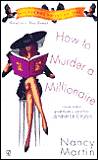
Book Banter -- How to Murder a Millionaire


Title: How to Murder a Millionaire
Author: Nancy Martin
Length: ~270 pages
Genre: mystery/chick lit
Plot Basics: Nora Blackbird's parents take off leaving her and her two sisters nothing but their family estate, some antique furniture and a stack of bills. To help make a dent in family debt Nora takes a job as a society columnist offered to her by a close family friend, Rory Pendergast, owner of the newspaper. At a swanky party Rory hosts, Nora finds him dead and decides that she needs to become an amateur sleuth and find out who the murderer is.
Banter Points: Charming. With so many female amateur sleuths out there, Martin does a good job of giving Nora some quirks to set her apart.
Bummer Points: Since it's a chick lit/mystery book, Nora of course has to meet a handsome but mysterious man. Word Nerd felt like honestly there were scenes between them that must have been cut in the final manuscript because their burgeoning relationship felt very choppy.
Word Nerd recommendation: It's cute enough and quirky enough that Word Nerd will check out the other books in the series.

04 August 2006

Book Banter -- Pale Immortal


Title: Pale Immortal

Author: Anne Frasier
Length: ~360 pages*
Genre: thriller/horror
Plot Basics: In the small town of Tuonela Wisc., a legend exists about the Pale Immortal, a killer that resembled a vampire. Now, 16-year-old Graham Yates is dumped off in Tuonela to meet his father. But Graham shows up around the same time as a dead body. And the cause of death, determined by medical examiner Rachel Burton, points to signs that the Pale Immortal may be back. Rachel, Graham and the town's mysterious researcher Evan Stroud all end up tangled in the investigation of the murder and a fight for their lives.
Banter Points: WOW. Word Nerd's guilty little reading pleasure is vampire stories but this one takes the cake for the best one she's read in a long time. It's a great horror book because it doesn't make you turn on all the lights and look for things that will leap out of dark corners at you: lights on or off, the scary part of this book is all in your head.

Evan Stroud is a fascinating and complex character. Word Nerd can't say too much about him without giving away plot, but he made the book.

All those back-of-book-cover snippets like "hard to put down," "a real page-turner" etc, absolutely apply.

Bummer Points: Frasier's at work on a sequel but Word Nerd's going to have to wait for more than a year before that will be available.

Word Nerd recommendation: Pale Immortal releases on Sept. 5. Go buy it. In the meantime, check out www.paleimmortal.blogspot.com to read the first chapter and see some photos Frasier took of the real Tuonela Wisc.

*Word Nerd read an advanced reader copy of this book. An ARC is actually a set of uncorrected proofs, so the final page count can/will vary from the number in the ARC.

03 August 2006

Book Banter -- The Judas Goat

Title: The Judas Goat
Author: Robert B. Parker
Length: 208 pages
Genre: mystery
Plot Basics: Spenser goes to London at the behest of Mr. Dixon whose family was killed there by terrorist bombers. Dixon hires Spenser to track down those responsible and deal with them.
Banter Points: This is the first book Word Nerd read with Spenser's sidekick/partner Hawk. (Somehow, she picked up bk 5 before bk 4 where he's introduced, but oh well). Hawk adds a new dynamic to the Spenser stories because he's even colder and more calculating than Spenser. He's also a humorous addition.
Bummer Points: Word Nerd likes the Spenser books... like the character, the taut writing... she does not the over-reliance on violence. (Many more fisticuffs were used to solve the problem in this book.)
Word Nerd recommendation: After reading four Spenser books in quick succession, Word Nerd's going to take a break for a bit. She'll come back though.

02 August 2006

July Bibliometer

July was a pretty good month for getting through a lot of books.
The grand total for the month was 9 books (all written by men since this was the July Experiment... see the post a few days ago for an explanation of the July Experiment.)

So the statistics (because Word Nerd knows that the numbers are really what you are interested in).

9 books = 2419 pages = average 78.03 pages/day.
The books.
Sandman: Fables and Reflections, Neil Gaiman
Things My Girlfriend and I have Argued About, Mil Millington
The Star Fraction, Ken Macleod
The Godwulf Manuscript, Robert B. Parker
Creepers, David Morrell
God Save the Child, Robert B. Parker
Mortal Stakes, Robert B. Parker
Adverbs, Daniel Handler
The Judas Goat, Robert B. Parker

Word Nerd did a little math and also discovered that in the first 7 months of 2006, she's read 20,738 pages total for an average of 98 pages/day thus far this year.

01 August 2006

Author Answers with Susan McBride

Say hey to this week's author -- Susan McBride.

McBride is the author of the Debutante Dropout Mysteries, and her newest book, Night of the Living Deb, is slated for release in January 2007. The series starts with Blue Blood, The Good Girl's Guide to Murder and the Lone Star Lonely Hearts Club -- all the books feature plucky heroine and amateur detective Andy Kendricks. McBride's also starting to work on a YA series, "The Debs."

She's got a website here and she's also a regular contributor to The Lipstick Chronicles.

WORD NERD: Place you do most of your writing:
MCBRIDE: I have a spare bedroom in my condo which I've dubbed my writing room, and that's where I work. I finally took the time to paint and spiff it up a year ago, and it was worth it. It's such a comfortable space. Though I'm about to move into a new house, and I've already picked out my new writing room. So I get to do the painting and decorating all over again!

WN: What’s your writing process like from when you get an idea to when it gets published?
MCBRIDE: I'm on a book-a-year schedule with HarperCollins right now, which means I stay a year ahead of myself. So I'll be finishing the fifth book in my Debutante Dropout Mystery series by the end of December, just about when the fourth book, NIGHT OF THE LIVING DEB, comes out. I start mulling over ideas for the next book early on, well before I sit down to write. Once I let the story stew in my head for long enough--usually several months--I start getting itchy. Then I know it's time to rock and roll. In between writing, I'm often promoting, and I travel a good five to six months of the year doing mystery conventions, book festivals, bookstore and library events, whatever I can fit in my schedule. I don't think most people realize how much of a writer's life is spent on the road. With me, right now, it's about half the time (which is too much!).

WN: Why did you decide to become a writer?
MCBRIDE: I was always a writer, I think. I tell people it was in my blood. I started reading very early on, and I always surrounded myself with books. My mom has found short stories I wrote throughout grade school, and I have three books I wrote in fifth grade. I even loved the feel of writing longhand, even if it was just a grocery list. When I was 19, between transferring from the University of Texas to the University of Kansas, I had an epiphany during a car trip. I heard these words in my head: I will write a book. I took time off school and wrote a 700-page historical romance, which made the rounds of editors in New York and garnered some very encouraging rejections. That was it. That's all it took. I knew from that moment on that I was meant to write. I was hooked.

WN: How long did you have to work to get published and what made you keep working at it until your name was on the cover of a book?
MCBRIDE: I wrote a manuscript a year for nearly eleven years after I graduated from college before I signed a traditional publishing contract. It was a long, hard road but I would never have given up, not for anything or anyone. I found agents for various manuscripts, so I always had hope that something would sell. I never stopped writing either, starting a new book as soon as I finished one. It was great practice, as I wrote in different genres and different points of view, until I found my voice. I have total faith in my ability to finish projects, too, which helps tremendously when you have publisher-imposed deadlines. I remember, though, a family friend approaching me at my grandmother's funeral, when I'd gone ten years and ten manuscripts without selling, and he said, "Don't you think it's time you gave up?" That infuriated me and only made me want to work harder. Years later, after I was published, his mother came to one of my signings and bought him a book. I inscribed it with, "Sometimes dreams do come true." I should've added, "Take that, you big jerk!" When you'd just as soon stop breathing as stop writing, nothing anyone says will convince you to stop. I couldn't. I didn't. Now I'm finishing up my second contract with HarperCollins with a third looming on the horizon! (And another deal in the works that hopefully will become public soon--exciting!)

WN: Since your bio says you no longer live in Texas, how much research do you have to do to make Andy Kendrick’s adventures in Dallas believable for somebody who knows that area? What other sorts of things do you have to research when you are writing a novel?
MCBRIDE: I lived in Texas for half my life--Houston for eleven years and in Dallas for nine--so it's not hard to make my settings believable. The basic things haven't changed much: where the rich folks live, where the malls are, where the big-name hotels and restaurants are located. I can go online and look up information, which is great, plus I try to get back once a year. If I can't, I rely on friends to tell me what's what. Researching the Debutante Dropout Mysteries are a hoot, because their storylines often relate to subjects I'm interested in. I hate Hooters restaurants, so I offed the owner of a fictional restaurant called Jugs in BLUE BLOOD. The debutante dropout, Andy Kendricks, ends up working undercover in hot-pants in order to clear a friend arrested for the murder. In THE GOOD GIRL'S GUIDE TO MURDER, I kill off a Martha Stewart type character who's a friend of Andy's socialite mom, Cissy. I'd watched one too many of Martha's specials at that point and was feeling woefully inadequate, so that felt good. NIGHT OF THE LIVING DEB, set for a January release, starts out in a strip club...a real strip club in Dallas. A friend of mine generously agreed to accompany me so I could see the place and describe it. I'm researching plastic surgery (did you know Dallas is the plastic surgery capital of the world?), Botox parties, and related issues for TOO PRETTY TO DIE, which I'm just a few pages into. So basically, if I'm intrigued by something I hear about or read about in the news, it can blossom into the idea for a novel.

WN: What is the best/most influential book you have ever read and why did it inspire you?
MCBRIDE: Hmmm, that's a toughie, as I've read many influential books that have inspired me. High on my list is GONE WITH THE WIND, because it's such a fabulous example of pure story-telling ability. Margaret Mitchell knew how to spin a yarn, that's for sure. Lately, books like Mark Salzman's LYING AWAKE and Margot Livesey's EVA MOVES THE FURNITURE have proved inspiring just because the prose is so beautiful and lyrical. I love writing that's rich in voice. I can read those books over and over again, finding new things to admire every time.

WN: If you had to live the life of one of your characters, who would you pick and why?
MCBRIDE: I already feel like I'm living Andy Kendricks's life in many ways! She's always been an outsider, a simple girl brought up in a world of privilege who wants nothing more than to live her own life. I was forever the new kid in school, as my family moved around a lot when I was growing up, so I can identify with the feeling of not fitting in. I hung out with rich kids in high school and college (the idea for the Debutante Dropout Mysteries originally sprung from memories of watching the Dallas debutantes in my sorority practice curtsies during study hall); but I never wanted to be one of them. When things go right in my life--like finding a wonderful guy!--Andy's fictional life always ends up reflecting that. Writing books is my own form of therapy, I guess!

WN: What piece of advice helped you out the most as a writer?
MCBRIDE: As far as the technical side of writing, it's when in doubt, leave it out. When you're a fledging writer, every word seems so precious. You don't want to cut or change a thing. As you mature, you realize that taut, lean prose is far better than flabby, flowery prose. As Elmore Leonard said (I'm paraphrasing), "leave out whatever will bore the reader."
On a more spiritual note, it's to hang in there and continue writing if it's something you love doing. Don't listen to the naysayers and don't try to take shortcuts. If your goal is to be traditionally published, as mine was, don't bend, don't cave, don't quit. It's a tough business to break into, so use your time wisely, working on finding your voice and making your writing as strong and fresh as possible. Oh, and don't listen to rules or write by formulas. Be true to yourself. Be unique. No one else can tell your story but you.