Showing posts with label Reading Technology. Show all posts

11 January 2012

Books are not Commodities

The Digital Reader posted an interesting article about how Amazon has turned books into a commodity.

Their argument is that with the prevalence of eBooks, readers now search for better and cheaper alternatives.

I know that many of you will clamor to say that I am wrong, but I ask you to consider this: Once you have bought and read the latest release from your favorite author, do you stop buying and reading books until that author’s next release in 2 or 3 years or do you continue to buy and read books within that genre? And if you do continue to buy and read books, do you continue to be entertained by them or are you only entertained by books written by your favorite author? Finally, do you rush out to buy your favorite author’s newest release or do you wait for a less expensive edition to appear?
If you answer yes to the latter parts of each question (at least the first two questions), then books are commodities and substitutable.
Books may be commodities for some, the casual fans or sometimes-readers. But for those of us who are bibliophiles -- answering yes doesn't lead to the right conclusion.

I continue to buy and read books in my favorite authors genres because I enjoy the genre. I am entertained by the books of my favorite authors and look forward to them immensely and am happily surprised when new finds are just as entertaining, if not more so! I rush out and buy new releases, sometimes, and sometimes wait for less expensive editions. This is more about budgeting and whether I started collecting the series in hardcovers or paperbacks.

Books aren't really substitutable to me. While both Harry Potter and Harry Dresden are wizards operating in a magic world pushed up against our own, they are hardly substitutable for each other. Just because Michael Connelly and Tess Gerritsen write novels based in police procedure, Harry Bosch and Jane Rizzoli aren't the same as detectives. There's no substitute.

Does this mean that some fiction isn't just a cheap, derivative copy? No. We all know that exists and are terribly disappointed as readers when in our quest for something new, we run into something borrowed. It's the plague of a writer too to twist the conventions just enough that their new idea won't be that derivative offering.

I like the prevalence of eBooks. I appreciate that it's changing publishing and hopefully, eventually, for the better, opening the faucet of work out there.

Books have been becoming commodities ever since Gutenberg invited the printing press. We can hardly blame ebooks for making books into something that we can buy more of. And technology is only fueling the hearts of readers, not extinguishing them.

17 October 2011

The audiobook experiment, part I

With the new job, I've got a longer commute which is becoming prime audiobook listening time.

Previously, audio books kept me company while doing yardwork thanks to downloadable audio books. But when the next book I wanted wasn't available for my iPod but was on CD, I remembered, "Hey, my car has one of those!" So, audiobooks, meet drivetime.

But, my audiobook choices have always been books I already read. The audiobook was a way to "reread" and not worry about having to pay more attention to my driving (or gardening) than the book at hand because I knew what happened.

Except -- there's so much stuff I want to read for the first time.

And enter a Twitter question by @tyrusbooks: Does your appreciation/comprehension of a book change between reading and/or listening?

This question had been knocking around in my head as well. So, I replied: @tyrusbooks I'm going to find out! All my audiobook exp. has been "rereading" but going to try a new book just with audio to see.


That afternoon, I went to the library and checked out an audiobook I haven't already read in paper.

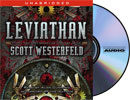
For the purposes of my experiment, I decided to go easy on myself. The book in question is the first in Scott Westerfeld's YA steampunk trilogy, Leviathan. Knowing I've got a stack of mysteries and urban fantasies checked out to read in print, I didn't want a book in those genres so I wouldn't confuse the clues or wonder why the magic isn't working right because that world works differently.

I popped disc one of Leviathan in the car last Wednesday and started to get into an alternate 1914, full of airships and steam-powered Stormwalkers.

The experiment is underway. And as @TyrusBooks asked: @BKWordNerd report back with your findings, B.


I'll keep you posted.


16 September 2011

#fridayreads

Have you been paying attention to the #fridayreads Twitter trend?

Some months back, the #fridayreads hashtag became quite well-used it it's great every Friday to see what people are reading.

There's lot of tweets out there about books, about authors, etc. I like the #fridayreads trend because it tends to go beyond that sphere of people who are regularly posting about the industry. #fridayreads is about regular people sharing about the books they love. Or maybe don't love. The point it, we're sharing about reading.

Some brilliant book bloggers (The Book Lady's Blog) captured @fridayreads and use it to award some free book prizes every week as well. Word Nerd was an early winner, scoring a copy of Kristina Riggle's "The Things We Didn't Say." It's on the TBR pile and Word Nerd finally getting through her stack of library books, so it should be in the reading now category soon.

Come join the trend on fridays. Who knows, you might be a winner too.

02 May 2011

Shelf Space

Not my real bookshelf
I think it's the curse of all book-lovers that we're perpetually running out of bookshelf space.

A few months back, I reorganized my shelves to accommodate all the books I had at the time. Everything was alphabetized, double-depth shelved paperbacks, non-fiction elsewhere. For an organization nerd, it was something like nirvana.

Then -- then Saturday night I went to one of the Borders here that's going out of business. The fiction was all marked down to 50% off. I know that reduces what the authors get from the sales (if anything, seeing as how Borders owes so much). But for a girl on a budget, it made buying some books possible.

And lo and behold, there on the shelf in the sci-fi section, the first five books of the Cal Leandros series by Rob Thurman. I have read the first five and loved them -- Cal's snarkiness, Niko's cool brotherly protection, Robin Goodfellow's innuendo's -- and have thought long and hard about owning them.

But now, I have FIVE new paperbacks to add to my already overcrowded bookshelves. The dilemma...

Am I the only one who thinks too much about how to organize books? What system do you use?

01 March 2011

Rumor Mongering: Free Kindles by November 2011

Check out this rumor I found on kottke.org, who heard it from Kevin Kelly, who heard it from John Walkenbach:

Kevin Kelly forecasts that Amazon will soon be handing out free Kindles...perhaps to Amazon Prime members.

In October 2009 John Walkenbach noticed that the price of the Kindle was falling at a consistent rate, lowering almost on a schedule. By June 2010, the rate was so unwavering that he could easily forecast the date at which the Kindle would be free: November 2011.

Since then I've mentioned this forecast to all kinds of folks. In August, 2010 I had the chance to point it out to Jeff Bezos, CEO of Amazon. He merely smiled and said, "Oh, you noticed that!" And then smiled again.

The Kindle has never been knock-it-out-of-the-park great...it looks like Amazon's strategy is not to build a great e-reader but to build a pretty good free e-reader.


I can see this. My boss' wife got a free Kindle when she went to an Oprah show. He firmly believes she never would have bought one, but now that she has it, she gets books for it.

14 January 2011

E-readers

When Amazon first introduced the Kindle, I had loads of people asking me if I was purchasing one. At the time, I declined, for a couple of reasons.

First, it was the cost. I borrow most of my books from the public library. The cost of the reader plus the cost of books would have added to my budget, instead of helping it.

Second, was it even feasible to curl up with a Kindle the way you could with the book? The few times I tested the Kindle in the store gave me a bad feeling about it.

Fast forward to early 2010. Apple introduces the iPad (midst many jokes and laughter over the name.)

It seems to me to be just a big iPod touch, which is cool. And I start toying with the idea of an e-reader again. My main objective again is the cost, except the publishing world is doing some interesting things in the electronic space, including pricing adjustments that make it seem possible.

And my local library offers software that I can use to read their books for free. Granted, the digital collection has some limits but there is still is a good selection.

However, as the hubby and I were discussing the potential of an iPad purchase (since I've been secretly lusting for one and desperately trying to justify the cost), I pull out the trump card: "Ya know, if it's good to read on, I could buy as many books as I like without you ever knowing how many books I really have."

Mission accomplished.

What are your thoughts on the e-readers?