The Word Nerds have moved to a new home on the internet.
You can find us over at thewordnerds.wordpress.com.
It's a new address and a new look, but the Word Nerd content you've come to expect.
Bookmark it. Tell your friends.
We'll be porting over the old content from here in the coming weeks, so don't worry that you'll lose the archive of author interviews, etc.
01 March 2012


27 February 2012
Book Banter -- The Enforcers
Title: The Enforcers (ARC)
Author: Joshua Grover David Patterson
Genre: urban fantasy
Length: ~300 pages (ebook ARC)
Where Word Nerd's Copy came from: @Groverdavid (AKA, the author)
Plot Basics: Spoiler Alerts...
Still newly-minted vampire Lucy Leary and her scooby gang (Emma, Wash, Charisma and Alex) are on the run from the Enforcers, the self-policing vampire hit squad. They've successful taken down two vampire baddies, but in this age of the Internet, their escapades are all over YouTube. Of course, the existence of vampires is a secret, and David, the head of the Enforcers, is determined to keep it that way. Lucy continues to wrestle with her new undead identity and how to protect her family. She's got a radical and dangerous idea, but if one domino in a chain of events falls wrong, it could spell her permanent death
Banter Points: This is the final book in Patterson's YA vampire trilogy (Blood Calling, The Misfits, The Enforcers) and it's a fairly satisfying conclusion to what he's set up throughout the books. The story arcs get bigger every time (personal problem, group problem, national problem) which provide nice rising action to make each book build in the series.
Bummer Points: The best book in the group is Blood Calling, but that doesn't mean it's not worth reading this one. The action is great in this one, but I was bummed to see that it didn't push the characters as far as they could have gone personally.
Word Nerd Recommendation: The trilogy is a nice and different entry into the vampire genre. Check out my review of Blood Calling to see why you should pick it up and why it's not the kind of vampire story you expect.
Author: Joshua Grover David Patterson
Genre: urban fantasy
Length: ~300 pages (ebook ARC)
Where Word Nerd's Copy came from: @Groverdavid (AKA, the author)
Plot Basics: Spoiler Alerts...
Still newly-minted vampire Lucy Leary and her scooby gang (Emma, Wash, Charisma and Alex) are on the run from the Enforcers, the self-policing vampire hit squad. They've successful taken down two vampire baddies, but in this age of the Internet, their escapades are all over YouTube. Of course, the existence of vampires is a secret, and David, the head of the Enforcers, is determined to keep it that way. Lucy continues to wrestle with her new undead identity and how to protect her family. She's got a radical and dangerous idea, but if one domino in a chain of events falls wrong, it could spell her permanent death
Banter Points: This is the final book in Patterson's YA vampire trilogy (Blood Calling, The Misfits, The Enforcers) and it's a fairly satisfying conclusion to what he's set up throughout the books. The story arcs get bigger every time (personal problem, group problem, national problem) which provide nice rising action to make each book build in the series.
Bummer Points: The best book in the group is Blood Calling, but that doesn't mean it's not worth reading this one. The action is great in this one, but I was bummed to see that it didn't push the characters as far as they could have gone personally.
Word Nerd Recommendation: The trilogy is a nice and different entry into the vampire genre. Check out my review of Blood Calling to see why you should pick it up and why it's not the kind of vampire story you expect.
24 February 2012
Book Banter: Dreamfever

Title: Dream fever
Author: Karen Moning
Genre: Fantasty
Length: 512 pages
Where Stacie's Copy Came From: Oshkosh Public Library
Plot Basics: Mac has become what every sidhe-seer fears: pri-ya. Forced into sexual relations with Fae Princes should be enough to kill her. Only Mac survives, with help from Barrons.
Finding and containing the Book continues to be the focus and the obstacles and stakes are higher than ever.
Banter Points: I love how Moning puts her characters through the ringer. She really makes them work for every bit of what they do, what they earn, and what they achieve.
There's a side character in this installation in the series that I love. Dani is a feisty teen who is the sister that Mac wishes she had, that she wishes she could have had.
At the end, there's a massive cliff hanger. One that makes me thankful that the series is complete and I didn't have to wait the 18 or so months inbetween this title and the next!
Bummer Points: This is the second to the last story in the series. As great as it is to see the complexity, I know it's going to end with the next title. And this one went way too fast.
Stacie's Recommendation: Start with the first book, Dark Fever. Leave yourself plenty of time to devour the series quickly.
23 February 2012
Composites
Ever wonder what a character in a book really looks like?
Artist Brian Joseph Davis is using art and criminal sketch software and coming up with "sketches" of famous characters in literature -- as if they were done by a police sketch artist. You can see growing collection of Composites online.
They are eerie, in a way, to see these characters brought to life in this medium.
They look like I think they do, sort of. Maybe it's the starkness of black and white pencil sketches. I think part of it is that none of them are smiling in the sketch and while I think physically, Daisy for example, looks the way she does in my head, I most often picture her grinning in her flighty, rich way.
The project is asking for people to submit other characters and their descriptions for future sketches as well.
If anybody puts one of these sketches in a "six-pack," it will hardly be the line-up of usual suspects at all.
 |
| Daisy Buchanan, The Great Gatsby |
They are eerie, in a way, to see these characters brought to life in this medium.
They look like I think they do, sort of. Maybe it's the starkness of black and white pencil sketches. I think part of it is that none of them are smiling in the sketch and while I think physically, Daisy for example, looks the way she does in my head, I most often picture her grinning in her flighty, rich way.
The project is asking for people to submit other characters and their descriptions for future sketches as well.
If anybody puts one of these sketches in a "six-pack," it will hardly be the line-up of usual suspects at all.
22 February 2012
Author Answers with Stacey Jay
So thrilled to be back with an author interview this week and also super thrilled that our special guest is Stacey Jay.
Jay: When I first started brainstorming this concept three years ago, I was living in Arkansas where the mosquitoes are horrendous. You can barely go outside after sundown without getting swarmed. And, of course, being a horror-leaning writer, swatting bloodsuckers made my story-wheels start turning. The original premise was that mosquitoes were biting fairies and then biting people, therefore infecting people with magic and connecting the Fey and human worlds. I was going to call it the Catching Magic series, and it was going to be a young adult project.
But over time--as I continued to brainstorm character and plot--I decided it would be better if the fairies were the creatures doing the infecting. The story got progressively darker from there, and I decided it would be best for series to be written for adults. That gave me the freedom to explore themes I wasn't comfortable exploring in a young adult book. (At least not at that time.)
Word Nerd: What's different about writing for adults than writing for young adults (other than content?)
Jay: For me I'd say it's all about perspective. As adults we feel things deeply, but I think most of us have a sense of our life as journey, with road reaching out in front and back behind. We have good times and bad, but we know that the place where we are right now is only a small part of the journey, and I think that helps adults remain a bit more grounded. As teens, emotions are so immediate and all-consuming, and a dream deferred for a moment can feel like a lifetime. When I'm writing YA, I really try to connect to that part of being a teenager. The stakes are high, and the players are oftentimes not in control of their own destiny (because they are still legally children) and that can whip up some intense feelings.
But I think all of my characters are "coming of age," even the adults. They're just coming to different ages, growing and changing and learning about themselves as the stories progress. I don't ever want to stop growing and I don't want that for my characters, either.
Word Nerd: On your blog, you mention that you're getting back into ballet. How does a hobby like that inspire you as a writer?
Jay: I think art always feeds art. (Adventure feeds art too. I love adventures.) I can't paint or draw to save my life, but going to a museum always inspires me. It makes the words come easier and energizes my creativity. For me, ballet was my first love. I danced from age three until I became pregnant with my first son at twenty-four. Ballet is the first place where I experienced the way discipline and practice (building technique) can lead to increased freedom and creativity (being able to trust the technique and funnel your entire soul into a performance). Ballet was my drug of choice for a lot of years. The high I get from dancing definitely inspires me. My only problem is getting my butt in the chair when I'd rather be off taking another barre class!
Word Nerd: YA has exploded in the past few years. When you were a teen, what were your favorites?
Jay: I loved scary reads from Stephen King (and R.L. Stein when I was younger). I also loved romance and the classics and poetry and plays.
Word Nerd: What's your favorite word and why?
Jay: Maybe. (It leaves room for possibility and I like possibility.)
Word Nerd: What's next for you as a writer?
Jay: Well, after BLOOD ON THE BAYOU, my next young adult book, ROMEO REDEEMED, will be releasing from Delacorte Press in October of 2012. I'm really excited to get that in the hands of readers and see what they think.
Thank you so much for the interview!
You can find Stacey at her website with all kinds of other good stuff and a list of all her books.
If you missed it on Monday, I posted a review of her newest book -- Blood on the Bayou -- and I'm going back to catch the first book and get myself fully entrenched as a fan of this series.
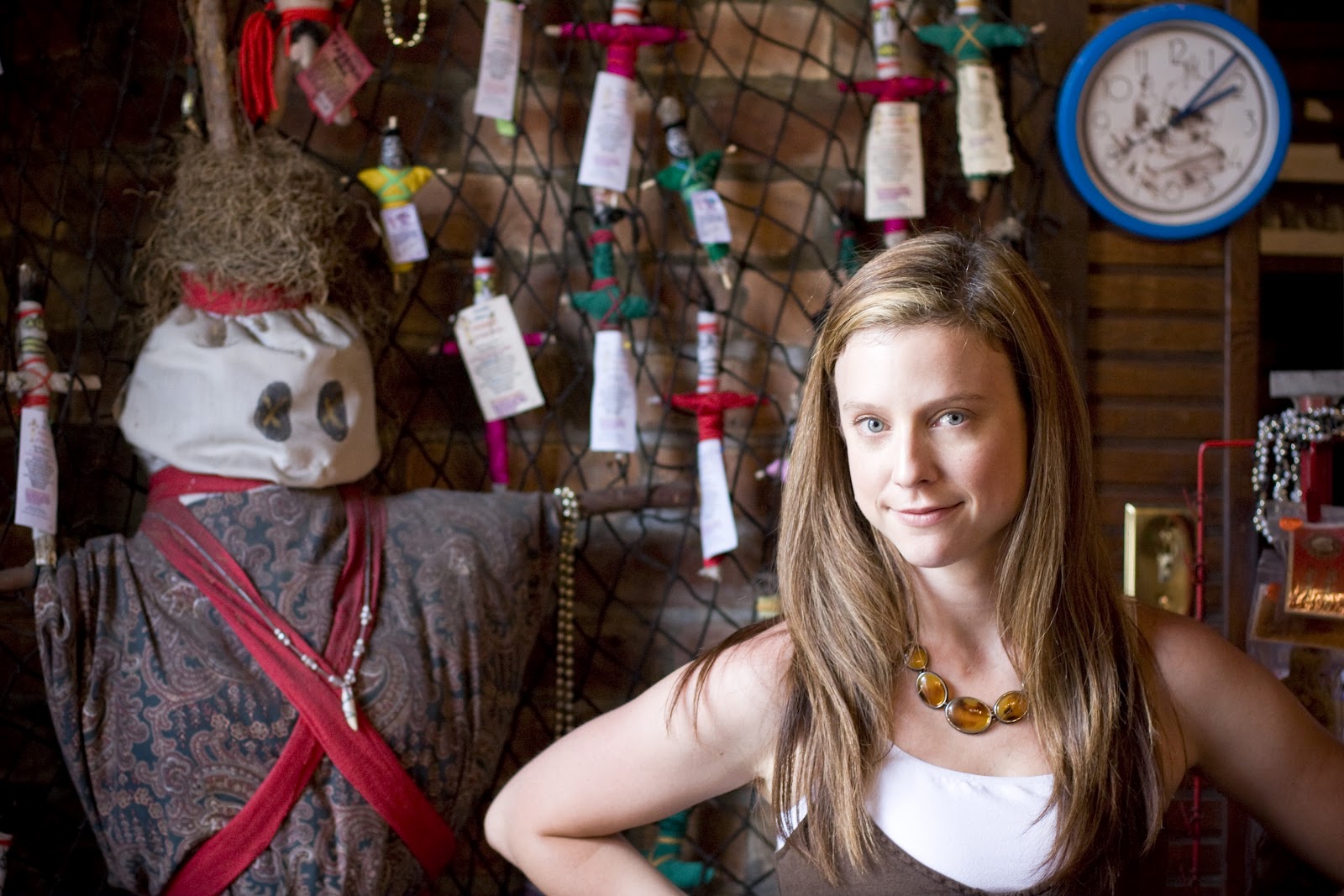 |
| Stacey Jay at the Voodoo Museum |
But now, Stacey herself taking on some questions about writing, books and loving words.
Word Nerd: Where did the idea for the Annabelle Lee series come from?
Jay: When I first started brainstorming this concept three years ago, I was living in Arkansas where the mosquitoes are horrendous. You can barely go outside after sundown without getting swarmed. And, of course, being a horror-leaning writer, swatting bloodsuckers made my story-wheels start turning. The original premise was that mosquitoes were biting fairies and then biting people, therefore infecting people with magic and connecting the Fey and human worlds. I was going to call it the Catching Magic series, and it was going to be a young adult project.
But over time--as I continued to brainstorm character and plot--I decided it would be better if the fairies were the creatures doing the infecting. The story got progressively darker from there, and I decided it would be best for series to be written for adults. That gave me the freedom to explore themes I wasn't comfortable exploring in a young adult book. (At least not at that time.)
Word Nerd: What's different about writing for adults than writing for young adults (other than content?)
Jay: For me I'd say it's all about perspective. As adults we feel things deeply, but I think most of us have a sense of our life as journey, with road reaching out in front and back behind. We have good times and bad, but we know that the place where we are right now is only a small part of the journey, and I think that helps adults remain a bit more grounded. As teens, emotions are so immediate and all-consuming, and a dream deferred for a moment can feel like a lifetime. When I'm writing YA, I really try to connect to that part of being a teenager. The stakes are high, and the players are oftentimes not in control of their own destiny (because they are still legally children) and that can whip up some intense feelings.
But I think all of my characters are "coming of age," even the adults. They're just coming to different ages, growing and changing and learning about themselves as the stories progress. I don't ever want to stop growing and I don't want that for my characters, either.
Word Nerd: On your blog, you mention that you're getting back into ballet. How does a hobby like that inspire you as a writer?
Jay: I think art always feeds art. (Adventure feeds art too. I love adventures.) I can't paint or draw to save my life, but going to a museum always inspires me. It makes the words come easier and energizes my creativity. For me, ballet was my first love. I danced from age three until I became pregnant with my first son at twenty-four. Ballet is the first place where I experienced the way discipline and practice (building technique) can lead to increased freedom and creativity (being able to trust the technique and funnel your entire soul into a performance). Ballet was my drug of choice for a lot of years. The high I get from dancing definitely inspires me. My only problem is getting my butt in the chair when I'd rather be off taking another barre class!
Word Nerd: YA has exploded in the past few years. When you were a teen, what were your favorites?
Jay: I loved scary reads from Stephen King (and R.L. Stein when I was younger). I also loved romance and the classics and poetry and plays.
Word Nerd: What's your favorite word and why?
Jay: Maybe. (It leaves room for possibility and I like possibility.)
Word Nerd: What's next for you as a writer?
Jay: Well, after BLOOD ON THE BAYOU, my next young adult book, ROMEO REDEEMED, will be releasing from Delacorte Press in October of 2012. I'm really excited to get that in the hands of readers and see what they think.
Thank you so much for the interview!
You can find Stacey at her website with all kinds of other good stuff and a list of all her books.
21 February 2012
Book Banter: Shades of Milk and Honey

Title: Shades of Milk and Honey
Author: Mary Robinette Kowal
Genre: Fantasy
Length: 320
Where Stacie's Copy Came From: Oshkosh Public Library
Plot Basics: Jane and Melody are young ladies from a distinguished family without a fortune to attract a suitor. Instead they must rely on their best features; for Melody it is her looks, for Jane, her skills with magic.
Banter Points: The intro sounded like it could have been for a Jane Austen novel until the magic part. The charm of this story is how magic used as a household art. Like an Austen story, the characters are delightful in their own way. Jane is plain, and frets over her nose, but is determined that a suitor should be true and accept her for who she is. Melody is obessessed with looks, and reminds me of one of Austen's flighty characters.
The novel captures the world of Austen well.
Bummer Points: The novel captures the world of Austen well enough.
The characters are very reminiscent of several of Austen's, with minimal originality. The execution was good until the end of the novel when several story lines are dropped instead of answered.
I liked the idea of the novel very much. The closely modeled characters would have been delightful if the execution had carries through the second half of the novel as well as it did in the first.
Instead it felt hurried.
Stacie's Recommendation: Skip it. There's a sequel that I have trouble seeing how it fits in. Maybe start there? It could be a better book.
20 February 2012
Book Banter -- Blood on the Bayou

Author: Stacey Jay
Genre: Urban fantasy
Length: 413 pages
Where Word Nerd's Copy Came From: ARC from Simon and Schuster
Plot Basics: Hard-drinking Annabelle Lee is barely recovered from her first big encounter with faeries and is called once again with her immunity to their venom and her magic to pursue truths she'd rather leave alone. This time, it's an ex-boyfriend doing the asking. Annabelle knows helping could bring relationship disasters -- especially when the gorgeous and sometimes-invisible-man Tucker keeps popping in and out of her life -- but friends are hard to turn down. But lies, she learns, can run far deeper than the swampy water of the delta...
Banter Points: Work recently sent me to the City by the Bay for a conference and with a long plane ride ahead of me, I settled in with this ARC. I normally don't like jumping into a sequel, but the characters and the setting was so vivid that it didn't matter. While I missed some references, sure, the story of this book was intriguing on its own to keep me turning pages. Annabelle was a great new entry in the heavily populated world of urban fantasy heroines, her hard-drinking tendencies were a new twist on the girl-not-having-her-life-together trope.
And -- it was a new urban fantasy world! While others have done fairies (I'm thinking Laurell Hamilton's Merry Gentry series here) they were again, the objects of the romance, a human equivalent. But Jay's fairies are scary, swarming things that have had a real impact on the world since they appeared.
Bummer Points: At the beginning (or maybe from the first book), I missed character descriptions, so I spent a good deal of the book wondering what people looked like and then being surprised by the descriptions when they were finally referenced again.
Word Nerd Recommendation: I've gone back to find book 1 (Dead on the Delta) and I'm a fan of this urban fantasy series and pushing it on unsuspecting friends. You've been warned.
Bonus: Check back on Wednesday, when Stacey Jay will be "here" for a Q&A.
Subscribe to:
Posts (Atom)