Showing posts with label Author Answers. Show all posts

22 February 2012

Author Answers with Stacey Jay

So thrilled to be back with an author interview this week and also super thrilled that our special guest is Stacey Jay.

If you missed it on Monday, I posted a review of her newest book -- Blood on the Bayou -- and I'm going back to catch the first book and get myself fully entrenched as a fan of this series.
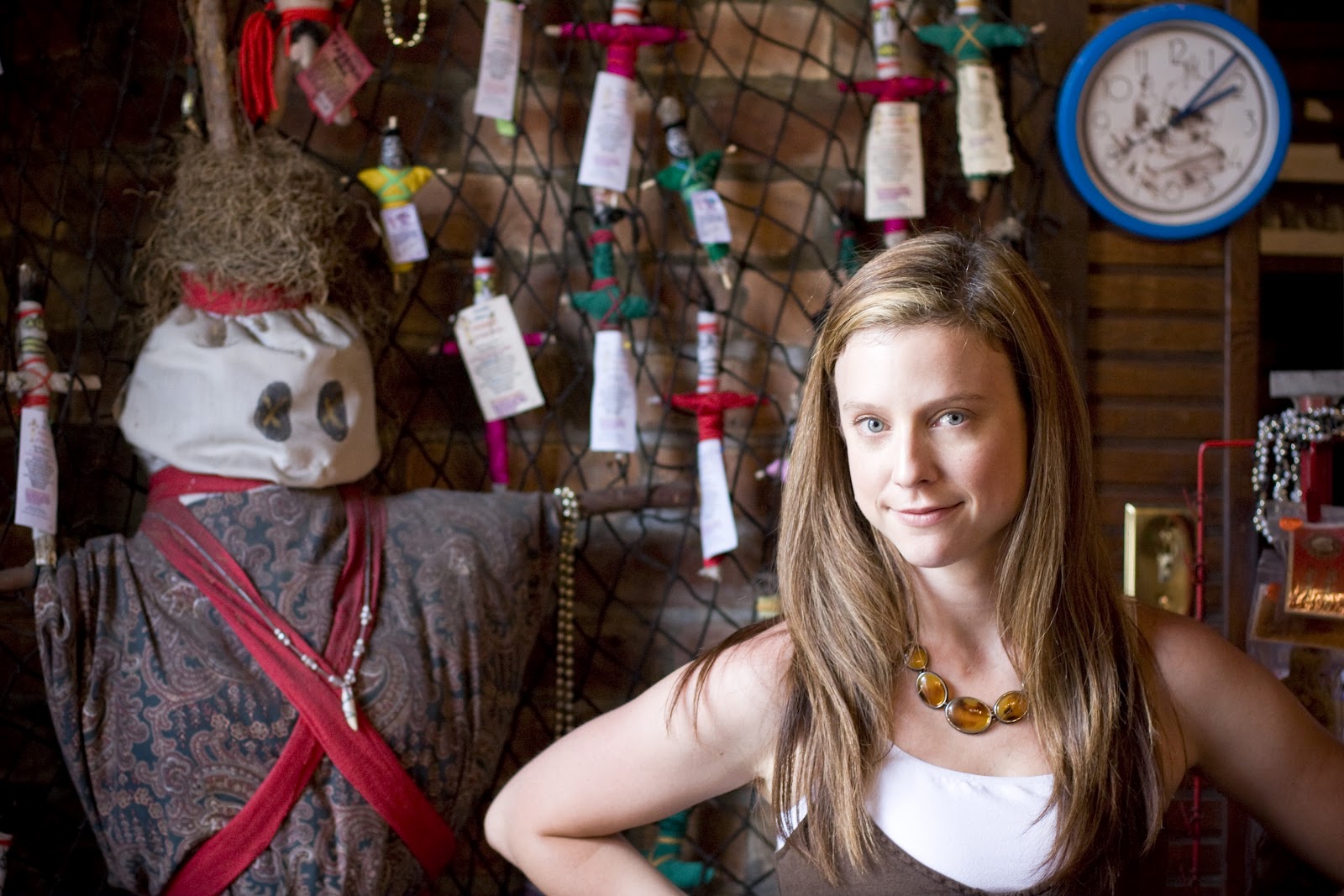
Stacey Jay at the Voodoo Museum
But now, Stacey herself taking on some questions about writing, books and loving words.

Word Nerd:  Where did the idea for the Annabelle Lee series come from?

 Jay: When I first started brainstorming this concept three years ago, I was living in Arkansas where the mosquitoes are horrendous. You can barely go outside after sundown without getting swarmed. And, of course, being a horror-leaning writer, swatting bloodsuckers made my story-wheels start turning. The original premise was that mosquitoes were biting fairies and then biting people, therefore infecting people with magic and connecting the Fey and human worlds. I was going to call it the Catching Magic series, and it was going to be a young adult project.

But over time--as I continued to brainstorm character and plot--I decided it would be better if the fairies were the creatures doing the infecting. The story got progressively darker from there, and I decided it would be best for series to be written for adults. That gave me the freedom to explore themes I wasn't comfortable exploring in a young adult book. (At least not at that time.)

Word Nerd: What's different about writing for adults than writing for young adults (other than content?)

Jay: For me I'd say it's all about perspective. As adults we feel things deeply, but I think most of us have a sense of our life as journey, with road reaching out in front and back behind. We have good times and bad, but we know that the place where we are right now is only a small part of the journey, and I think that helps adults remain a bit more grounded. As teens, emotions are so immediate and all-consuming, and a dream deferred for a moment can feel like a lifetime. When I'm writing YA, I really try to connect to that part of being a teenager. The stakes are high, and the players are oftentimes not in control of their own destiny (because they are still legally children) and that can whip up some intense feelings.

But I think all of my characters are "coming of age," even the adults. They're just coming to different ages, growing and changing and learning about themselves as the stories progress. I don't ever want to stop growing and I don't want that for my characters, either.

Word Nerd: On your blog, you mention that you're getting back into ballet. How does a hobby like that inspire you as a writer?

Jay: I think art always feeds art. (Adventure feeds art too. I love adventures.) I can't paint or draw to save my life, but going to a museum always inspires me. It makes the words come easier and energizes my creativity. For me, ballet was my first love. I danced from age three until I became pregnant with my first son at twenty-four. Ballet is the first place where I experienced the way discipline and practice (building technique) can lead to increased freedom and creativity (being able to trust the technique and funnel your entire soul into a performance). Ballet was my drug of choice for a lot of years. The high I get from dancing definitely inspires me. My only problem is getting my butt in the chair when I'd rather be off taking another barre class!

Word Nerd: YA has exploded in the past few years. When you were a teen, what were your favorites?

Jay: I loved scary reads from Stephen King (and R.L. Stein when I was younger). I also loved romance and the classics and poetry and plays.

Word Nerd: What's your favorite word and why?

Jay: Maybe. (It leaves room for possibility and I like possibility.)

Word Nerd: What's next for you as a writer?

Jay: Well, after BLOOD ON THE BAYOU, my next young adult book, ROMEO REDEEMED, will be releasing from Delacorte Press in October of 2012. I'm really excited to get that in the hands of readers and see what they think.

Thank you so much for the interview!

You can find Stacey at her website with all kinds of other good stuff and a list of all her books.

17 February 2012

What if Ghosts were Real? -- Guest Post

The Word Nerds are so pleased to introduce today's guest post from Sebastiene Elston about her book, Dead World. The Nerds read early chunks of the book and were enthused about it then and are delighted to showcase the finished product now.

This weekend, Dead World is free in the Amazon Kindle store. And to get you ready, we invited her to share some of how her thinking went to create this book.

What If Ghosts Were Real?
by Sebastiene Elston
Believe me. If someone could prove ghosts were real, it would change everything: how we view death, it would change religions, and it would change how we live each day. Immortality, in some form, would be proven. That knowledge would have a ripple effect that would eventually effect everyone and everything alive today.

Of course, it would be just our luck if it turned out the ghosts wanted to kill the living. Ever silver lining has a cloud, and every book needs a villain.

So, while other movie monsters like vampires and werewolves have had more movies made about them than anyone can count, I’ve never seen a ghost story that was... well, big. I have never seen a novel that dealt with the idea of ghosts on a national scale, which surprises me, because a "ghost" is a villain almost everyone understands.

So, I wrote that novel: Dead World. It’s the first book in the series of the same name. Just one book isn’t enough to contain this idea.

When people ask me what my book is about, I usually say, “It’s a really big ghost story.” They nod, but I know they don’t quite understand. It’s not a huge, doorstop of a book. (It’s a respectable 102,000 words, which is pretty standard.) What makes it big is that it’s about one family trying to survive while the entire country is slowly being killed by ghosts.

And just to be difficult, I didn’t make this novel an urban fantasy, either. The main character, Amber, isn’t gracing the cover wearing a cut-off shirt, carrying a sword/gun/knife/staff/ball of magic. She’s completely normal in every respect, except that she can clearly see the ghosts. That’s it. That’s the closest thing to a superpower she’s going to get.

The response I’ve been getting from readers is has been beyond anything I expected. I’ve had complete strangers writing 5-star reviews. How did that happen?

The good news is that you can get your own copy of Dead World free today at Amazon.com. Yes, the whole thing. Don’t have a Kindle? You can download the Kindle app onto your computer for free and read it there, if you’d like. But you might want to close your curtains, first. And take my sister’s advice. She won’t read it at night.

Apparently, if ghosts were real... it would be kind of scary.

And don't forget, this weekend, you can get your copy of Dead World for free through the Amazon Kindle Store.

19 October 2011

Author Answers with Tyler McMahon

After far too long of a hiatus on Word Nerd, we're back with Wednesday guest posts from writers. Kicking the series off again is debut novelist Tyler McMahon with a Q&A about his novel, "How the Mistakes Were Made."

Welcome, Tyler.

WN: What is it that drew you to setting a novel in the grunge music world of the 90s?
McMahon: Seattle—especially at this time period—has always cast a long shadow for me. I was 15 or so when Nirvana’s Nevermind was released. As a teenage misfit on the other side of the country, all the Sub-Pop and so-called “grunge” music—as well as the photographs and clever liner notes—fed a certain illusion that there was a place out west filled with people like my friends and me. It was a sort of Utopian vision for sloppy outsiders.

I was also interested in grunge’s relationship to earlier underground punk scenes. I think that the mainstream success of grunge gave them a certain validation. I wanted to show how marginalized or fringe artistic movements can shift the paradigm of pop culture—and grunge is a great example of that.

WN:  What kind of reader is going to really get into "How the Mistakes were Made"?
McMahon: I hope it has a fairly wide appeal. So far, I’ve been very flattered that readers with varying degrees of foreknowledge or experience with these music scenes have connected to it. Certainly, the novel doesn’t assume any punk or indie rock expertise.

Certainly, Gen X readers who grew up with Nirvana and their peers should find some resonance. However, I conjured up this idea when I was a Teaching Assistant, lecturing to college freshman about rock history. So I’ve always held out hope that the book might appeal to a younger readership, and to folks that might not otherwise read a lot of fiction.

In an odd and personal way, I truly hope that readers in the Northwest will get into the book. I started this novel after living in some small towns in Idaho and Montana, and there’s a way in which How the Mistakes Were Made is my love song to that part of the world. It’s a beautiful region full of big-hearted, creative people, and it deserves more attention that it gets in contemporary literature.

WN: You've written a lot of short stories -- what were the biggest challenges in writing a novel?
McMahon: I was ridiculously lucky in that—as a young writer towards the end of my graduate study—I stumbled into a sort of accidental apprenticeship with Brady Udall, an amazing novelist and teacher. He was my thesis advisor, and also taught a course on novel structure. Between those two things, I had a year of novel “training” that very few writers ever get.

I’ve given a lot of thought to the differences between short stories and novels in the past few years. Others have said that novels are more like drama, and that short stories are more like poetry. I’d say that’s accurate. But to my mind, novels have two fundamental requirements that shorter pieces might get away without.

The first is that a novel’s protagonist must—to some extent—be likeable. You can’t ask a reader to spend that many pages with a voice that they loathe. That’s not to say that protagonists have to be nice and charming, but they must show some redeeming qualities and inner humanity.

The second is that a novel must control tension and release—almost the way that a song does. With short stories, I used to get away with simply ramping up the tension for ten or twenty pages and then breaking the action off decisively. With novels, it’s necessary to ease up at times and let the characters catch their breath.

WN: How did your Peace Corps experience contribute to writing a novel?
McMahon: My time in El Salvador informed so much about my life since; I almost can’t imagine what things might be like if I’d not had that experience. It was certainly good training for a writer: you work on projects that are difficult, thankless, and often don’t make any sense to people outside of a small group of peers.

In another way, all the Peace Corps Volunteers I knew in El Salvador were storytellers. We might only see one another every few weeks, but our ritual gatherings invariably consisted of late-night bull sessions. We all tried to top each other with stories and anecdotes from our villages and rural communities. Some of the accounts would be second- or third-hand. The best ones would be repeated over and over, often by request.

Because that was a small community of people with shared experiences, we had a kind of shorthand, and a highly idiosyncratic lingo. Once back in the States, I often had to “translate” those stories to other friends and family. It was a great lesson in how to specific details can both pull readers in and push them out.

WN: What's next for you as an author?
McMahon: I’m a little superstitious when it comes to talking about works-in-progress. But at the moment I’m working on a manuscript about some expat surfers stuck in El Salvador in the wake of the earthquakes that devastated the country in early 2001. There’s a small port town there called La Libertad, which has an incredible world-class point break, along with an insidious crack-cocaine epidemic. The juxtaposition has always fascinated me.

It’s a subject that’s close to my heart, but the piece has moved in stops and starts, and been fraught with setbacks and second guesses. I’m hoping I can get a version of it into shape sometime in the next few months.


08 June 2011

Author Answers with Jennifer Wylie


Today's answers come to us from Jennifer Wylie. Jennifer writes short stories as part of Echelon Press' Shorts project. Jump in to find out more!

WN: What does a reader need to know about your series of short stories, Tales of Ever?
JW: Each story is between 13 and 15 thousand words, so as short stories go they are on the longer side. Part of Echelon Press' Electric Shorts project, they are geared toward 13-17yr olds. Each has been written to be fast paced and a fun read. The goal is to get more teens reading! Hopefully both the writing style and length will accomplish this and get at least a few more kids hooked. That said, Ever is certainly an interesting world, with a variety of characters even adults enjoy. For any lovers of paranormal or fantasy they will be a fun and exciting read!

WN: Let's dish: what character are you most like? Why?
Honestly none of the characters in my Tales of Ever series are very much like me. However Ever is a world where mostly evil people are banished LOL. If anyone I would say I'm closest to my main character Misha. Or maybe I was when I was sixteen. She deals with a lot of uncertainty and normal teenage feelings on top of everything else. Of course I'm not an orphan or a firestarter, though the later would certainly be cool!


WN: What's up next for you? More Tales of Ever?
JW:Yes! Tales of Ever will have six installments. One comes out each month, the 6th in August. I'll be busy writing and editing them up until then. This project has certainly kept me busy!
I also have my very first novel coming out in June, both in print and as an eBook. Sweet Light is an adult romantic fantasy and I'm super excited about its release.


WN: Short stories present a different challenge then novels. Tell us why you like the short story format.
JW:I've always loved short stories. When I was younger (back in public and high school) I wrote a few and then got sucked into novels. I actually didn't start writing short stories again until about a year ago. The main problem I have is ending them. I grew so used to writing and writing and writing it seems in no time at all I hit my word count for a short. I've had to teach myself to at least vaguely plan out a story line, or at least how the story will end, so I don't turn a short into a novel.
One of the main things I love about shorts is how quickly the whole process goes. It's very satisfying to complete a project and this happens much sooner with shorts, not only with the writing, but later the editing process as well.


WN: You are both author and acquisitions editor. What's it like playing the dual role?
JW:Very crazy, and hectic. I'll admit my writing time has been cut back a lot. I constantly wish for a clone, or a maid! As a stay at home on top of everything else I'm very rarely not busy with something or another.

WN: Any tips you'd like to share for authors who submit to you or Echelon Press?
JW: Do your homework. This applies to all aspects. Submit the correct genre to the right person. Follow the guidelines. Do some research on how to write a great query letter and synopsis. Most of all, make sure your book is ready to be read! Edit edit edit. If you can have someone else read or edit as well. You don't have to hire someone, even a friend or writing group can help. Do research on this as well. There are many articles online about editing do's and don'ts, things to watch out for etc.


WN: What question should the Word Nerds have asked, but didn't?
JW: How to find out more about me and my work of course! I'm all over the web and love to 'talk' with readers and fellow writers.
All of my published work is available in eBook formats at Amazon, Barnes and Noble, Smashwords and OmniLit.

My website: www.jenniferwylie.ca


My blog: http://jlwylie.wordpress.com/

twitter: @jen_wylie

goodreads: http://www.goodreads.com/author/show/4499919.Jen_Wylie

facebook fan page: http://www.facebook.com/pages/Jennifer-Wylie/151266004895266


Bonus Author Bio:

Jennifer Wylie was born and raised in Ontario, Canada. In a cosmic twist of fate she dislikes the snow and cold.

Before settling down to raise a family, she attained a BA from Queens University and worked in retail and sales.

Thanks to her mother she acquired a love of books at an early age and began writing in public school. She constantly has stories floating around in her head, and finds it amazing most people don’t. Jennifer writes various forms of fantasy, both novels and short stories. Sweet light is her debut novel to be published in 2011.

Jennifer resides in rural Ontario, Canada with her husband, two boys, Australian shepherd a flock of birds and a disagreeable amount of wildlife.

25 May 2011

Author Answers with Jennifer Nielsen

Today's answers come from Jennifer Nielsen, who writes two series for kids. Let's dive in.

WN:
I love the first paragraph of your bio -- For as far back as Jennifer can remember, she has shared her brain with imaginary characters. She figures it’s okay if she talks to them as she’s working on her stories, as long as they don’t start talking back. -- Tell us more about your process though. Who's really in charge, you or the characters? (Personally, when I write, I feel like I am eavesdropping on someone else's conversation at times.)

JN: I come from a theater background, and one thing an actor learns very early is that acting is all about making choices, so that their character creates the events rather than simply responds to them. This isn’t so different from a writer’s job, only the writer is making these choices for all the characters of the story.

So as I’m writing, I spend a lot of time in my head stepping into the shoes of my various characters and interacting with them almost as if it’s the scene of a play. I might review the same scene over and over, each time through a different character’s eyes. By doing this, I often discover a lot of options that wouldn’t be clear to me otherwise. I can also feel their resistance when I try to take the plot in a direction that might be inconsistent with a character’s personality – because the scene just becomes too forced and unnatural.

It’s similar to what you say – that you feel like you’re eavesdropping. Only in my case, I prefer to sneak into the conversation and participate.

WN: What’s something readers or their parents should know about Elliot? And are the goblins friendly?

JN: My favorite thing about Elliot is that he’s just an ordinary kid – and like all ordinary kids, there is something extraordinary that he hasn’t yet discovered about himself. At its core, this is really what the series is about – Elliot is a boy who learns that everything he needs to be amazing is already within himself.

And no, the Goblins are definitely not friendly. In ELLIOT AND THE GOBLIN WAR, they’ll try every trick they have to officially get rid of Elliot, including blowing up his house. Unfortunately, as the series continues, he has even more unfriendly creatures yet to deal with, including troublesome Pixies, a vengeful Yeti, evil Shadow Men, and a large demon who really, really, really does not want to be woken up from his nap.

WN: Let’s dish: what character are you most like? Why?

JN: I think every author puts a little of herself into each character she creates. So maybe the easiest way to answer this is to say which characters I’m least like. Which are the Goblins, for the obvious reason that I love chocolate, and they don’t. Oh, I should probably also include that they’re really horrible, despicable creatures, whereas I have never, ever blown up anyone’s house.

WN: What's up next for Elliot?

JN: ELLIOT AND THE PIXIE PLOT will be released in August 2011 and I’m so excited for people to read it! In this story, the mischievous Pixies kidnap Elliot to the Underworld in a plot to ransom Grissel the Goblin from the Brownie prison. The Goblin War might have been bad, but if Elliot fails, he’ll launch a war that will brand him as the kid who got earth destroyed. Who’d want to be his friend after that?

WN: Elliot isn't the only series you write. Who is the false prince?

JN: THE FALSE PRINCE is a very different series than ELLIOT and will launch with Scholastic in April 2012. It’s the story of four orphans, including a defiant boy named Sage, who are forced into competition to become an imposter prince. Sage’s life balances on a sword’s point. If he is not chosen, then he will certainly be killed.

THE FALSE PRINCE is full of suspense, danger, swordfights, and a boy whose voice is fiercely compelling. I hope people will love this story as much as I do.

WN: Writing for kids must lead to some good stories about your fans? Will you share one with us?

JN: I do have one favorite – after a school visit last fall, a 1st grader came up to say hello to me. She was an adorable little girl who wanted so much to have a way to thank me for coming. She pulled from her pocket a pink plastic jewel, so small I had to hold it close to see it, and covered in lint. That was her gift to me, and I still treasure it.

WN: What question should the Word Nerds have asked, but didn't?

JN: The Word Nerds might have wondered what is my favorite kind of ice cream (chocolate with marshmallows). Or better yet, if someone wanted to invite me for some ice cream, you can reach me at my website, www.jennielsen.com, and learn more about my books while you’re there!

Mmmm...ice cream is always good. Thanks for the answers, Jen!

18 May 2011

Laura Lippman Giveaway!

Want Laura Lippman's latest book? Or how about the one that kicked off her series, Baltimore Blues? This is your chance.

Word Nerd's got one copy of Baltimore Blues and two copies of her new one, I'd Know You Anywhere to give away today.

Rather than us going on about the new book, here's a video from Laura herself:

And for those of you reading at work or somewhere where watching a video doesn't work so well, here's some book jacket copy and reviews from others. 

There was your photo, in a magazine. Of course, you are older now. Still, I'd know you anywhere.
Suburban wife and mother Eliza Benedict's peaceful world falls off its axis when a letter arrives from Walter Bowman. In the summer of 1985, when Eliza was fifteen, she was kidnapped by this man and held hostage for almost six weeks. Now he's on death row in Virginia for the rape and murder of his final victim, and Eliza wants nothing to do with him. Walter, however, is unpredictable when ignored—as Eliza knows only too well—and to shelter her children from the nightmare of her past, she'll see him one last time.
But Walter is after something more than forgiveness: He wants Eliza to save his life . . . and he wants her to remember the truth about that long-ago summer and release the terrible secret she's keeping buried inside.

“Laura Lippman is among the select group of novelists who have invigorated the crime fiction arena with smart, innovative, and exciting work.” —George Pelecanos


“This is a story that grips you not with suspense but with its acute psychological autopsy of a survivor. Lippman’s knack for elucidating the horrors humans can inflict on one another through violence and manipulation — while telling a compelling story —is disarming and fascinating.” —USA Today

Lippman’s taut, mesmerizing, and exceptionally smart drama of predator and prey is at once unusually sensitive and utterly compelling. —Booklist

Lippman’s dedicated fans will find themselves well rewarded with I’D KNOW YOU ANYWHERE, an exceptional novel in every way, which is sure to gain her many new followers.” —San Diego Union-Tribune

How to win one of these books? 1. Live in the US or Canada. Sorry folks across the pond.... 2. Post a comment to enter about somebody you'd recognize anywhere, or wish you could run into again, or if all your loved ones are around you where you want them, just put your name in the hat. For extra emtries, post a link to this contest on FB or Twitter and copy it into the comments so we can track entries!

Three winners will be drawn next Monday, 5/23. The contest is open to everyone, even if you've won before.

04 May 2011

Author Answers with J.T. Ellison 2.0

Welcome thriller writer J.T. Ellison back to Word Nerd. She first appeared here in 2006 when she was a part of Killer Year and her first book was on its way to shelves.

Six books later, we're happy to have her back to talk about her latest, "So Close the Hand of Death."

WN: So Close the Hand of Death is the 6th Taylor Jackson book. What's it been like to push this character to this point?
J.T.:  It’s been rather amazing, actually. It’s hard to believe it’s been seven years already. She’s such a fun
character, almost a friend to me now. When she hurts, I hurt. When she bleeds, I bleed. When she’s happy,
I’m happy. I love how she’s changed over the course of the books – no longer living in a world that’s so
black and white, she’s learned how many shades of gray exist out there.

WN: To write thrillers, you have to come up with some pretty nasty killers. Is it hard to come up with "bad guys" like that, why or why not?
J.T.: Not really. I tap into my fears, and the fears of people around me, and magnify them into nearly grotesque proportions. I take solace in the fact that nothing I can create in my own mind is nearly as bad as reality.

WN: Of course in thrillers, you also have the "good guys." What was the thought process in strengthening your protagonist, Taylor Jackson, to go up against all these killers?
J.T.: Taylor is a rare beast in the crime fiction world – a cop without a nagging trauma in her past to drive her.
She’s strong because that’s who she is, and she commands the respect of her peers. I like that part of her;
it’s what gives her courage in the face of adversity. And of course, not all the books involve serial killers, so
she faces the same horrors our cops do on the streets every day.

WN: What's changed (or hasn't changed) about how you write since you first wrote "All the Pretty Girls" to now?
J.T.: I’m a little less organic, because I have to share with my agent and editor what I’m working on. I’m writing faster now too – no more leisurely pace. So it’s changed quite a bit, actually. But the essence remains the same – find a way to tell a great story that will keep the reader engaged and entertained.

WN: You're one of the many authors out there on Twitter (as @thrillerchick). How has being a part of that online community helped or hindered you as a writer?
J.T.: It’s so much fun. I didn’t start tweeting as part of a marketing platform, or to promote myself. Hence the
name – I chose something I hoped was discreet so I could be anonymous. I got outed after a few months
and had to own up to who I was, so it changed a bit. But that’s the one place I’m really myself. It’s great for
news, socializing – all the water cooler aspects of a job that we writers don’t experience because we’re off
on our lonesomes.

WN: What's next for you as a writer?
J.T.: Nirvana, actually - more writing. The 7th Taylor Jackson comes out September 20, WHERE ALL THE DEAD LIE. I have a multi-book contract that I’m working on right now, I just released a short story collection called SWEET LITTLE LIES, and I have two new shorts in anthologies this year. Life’s pretty sweet right now – and that’s not a lie!

Thanks so much for having me!

27 April 2011

Author Answers with Taylor Morris

Today's Answers come from Taylor Morris. Taylor writes for 'tweens. Check it out.

WN: How did you become a writer for 'tweens?

TM: The short story is: When I submitted my first novel to my agent, he suggested the story was a bit more suited for tweens than my intended young adults, and I agreed to change the age by two years, down to 13. This was excellent advice, and I’ve found it a great age to write about.

The long story is that it all began in college. I was in a writing workshop at Emerson College and I wrote a story set in high school. The class really liked it and I got some great feedback, but all the other students wrote super-serious stories that were dark and had adult issues. I thought that maybe what I was writing wasn’t serious enough and I needed to do what my classmates were doing, so the next week I wrote a story about something I knew nothing about. This is embarrassing. *takes deep breath* I wrote about a high-powered executive who can’t take the pressure so she leaps to her death off a high rise in downtown L.A. I knew nothing about being a high powered anything, especially not an executive, nor did I know anything about feeling suicidal. I had minimal knowledge of downtown LA.

The feedback was mortifying. They were nice, but they also had nothing good to say about the story. Finally someone said, “Why don’t you write like you did last week?” The class agreed they liked that genre from me, and that I did it well. I told myself I’d never go back.

WN: What is it like writing for that age group? Any great stories to share?

TM: The great thing about writing for tweens is that many of the experiences the characters go through are so new. First crushes, first big fights with friends, navigating cliques, making moral choices, good stuff like that.

WN: If you had to actually live the life of one of the characters in your book(s) who would you want to be and why?

TM: I would like to be Lucia Latham of TOTAL KNOCKOUT. Despite the punches I put her through in the book, I like her because she’s much more self-assured than I’ve ever been. She plows forward for what she wants, and she’s always sure that she’s going to get it. If there’s an obstacle in her way, she’ll figure out a way to get around it. Those are great qualities. Plus, her best friend, Cooper, has a trampoline and parents who cook amazing food—huge bonuses in a best friend.

WN: What kinds of things are you doing when you are not writing?

TM: I love, love, love to travel. Any chance I have to visit a new country, I go! But since that’s an expensive hobby, I also really enjoy hiking at Breakneck Ridge in Cold Spring, NY (fresh air and nature!), and walking for miles around New York City, especially with my friend Jessamyn and her little dog, Golda. One of our last walks was eight miles from Queens and through Brooklyn on one of the most perfect spring days of the year so far.

WN: Most of your books are about a pivotal moment in a pre-teens life - an embarrassing mom, blending in, gossip, etc. What makes this a great place for you to write in?

TM: For one, there’s always lots of drama in this age group to write about—and by the way, drama is so much more fun to write about than it is to live in. Also, like I said earlier, many emotions are being experienced for the first time but you’re also learning how to handle your emotions. Usually they go spilling over because everything in life is so heightened at this age, so something like your mom picking you up in her clunky car right in front of the movie theater while all your friends—and your crush—are standing there watching can feel utterly humiliating. Believe me, I know this to be absolutely true.

WN: I have to ask - any daughters?

TM: Nope, no kids at all. I have three amazing nieces, though, each of whom I’ve dedicated one of my HELLO, GORGEOUS books to. The oldest, Haden, is almost 10 and reminds me of how I felt at her age—moments of uncertainty, moments of feeling bold, and lots of moments of wondering where you fit in.

WN: What question should the Word Nerds ask, but haven't?

TM: Good question! You should have asked me which book is closest to something that has happened to me in real life. I totally would have told you—and the true story is as good as the fictional story.

C'mon, Taylor, don't leave us hanging! What about a follow-up in the comments?

20 April 2011

Author Answers: Jennifer Estep


Today's Answers come from Jennifer Estep, the author behind the Elemental Assassin series. I happened upon Estep's work while looking through Amazon's recommended reads for me. Boy, am I glad the algorithm was working that day. I'm a big fan of Gin Blanco, assassin for hire.

WN: Ashland is a tough place to live. The upper class regularly hires assassins to take out their enemies. And Gin is one of the best. Tell us more about what drives Ashland and those that live there.

JE: Well, like you said, Ashland is definitely a dark, gritty, corrupt, Southern city. It’s every man and woman for themselves in Ashland, and since the cops are so corrupt and crooked, the only justice that people get is what they make for themselves – with whatever weapon happens to be handy. LOL.

When I decided to write an assassin character, I wanted to put her in a world that would justify some of her actions. That’s why I made Ashland such a dangerous, volatile place. In Ashland, the rich scheme to get richer and bring down their enemies, while the middle- and lower-class folks are just trying to survive – something that Gin helps them with from time to time by doing her own brand of “pro-bono” work.

WN: Gin Blanco has a bit of Robin Hood in her; she takes the time and effort to help others, especially the down trodden. It is something that her mentor, Fletcher Lane, did as well. How does this fit into their lives and after hours work.

JE: Even though she’s spent most of her adult life being an assassin, Gin hates bullies more than anything else. So when she sees that someone – a good, innocent person – is being bullied or threatened, she finds herself stepping in to help them, even if it puts her in danger.

Also, family is very important to Gin since her mother and older sister were murdered, so when someone’s family is also threatened, well, that really pushes Gin’s buttons and makes her even more determined to protect and help them – no matter what.

I think it’s also a little bit of atonement as well, a way to balance out some of the bad things that Gin’s had to do herself over the years.

WN: Gin's love life - it's the one place she isn't in charge. Tell us more about the men she is (or isn't) attracted to.

JE: Well, in Spider’s Bite and Web of Lies, Gin’s love interest was Donovan Caine, a real straight-arrow detective. But at the end of Web of Lies, Donovan decided that he just couldn’t come to terms with Gin being an assassin and he left Ashland.

Lucky for Gin, sexy businessman Owen Grayson was more than happy to step up in Venom and let Gin know that he had no problems with her being an assassin, since he’s done some of the same bad things that she has over the years to keep his younger sister safe. Gin likes Owen, but she’s struggling to figure out how she feels about him … something that’s a big part of Tangled Threads, the fourth book in the series.


WN: Family is incredibly important to Gin, especially since she lost her own at such a young age. Any hints for the readers as to what's in store?

JE: Well, I can’t give out too many spoilers, but I’ll say that there’s a lot of emotion and interaction between Gin and her long-lost sister Bria in Tangled Threads. Their relationship is one of the things that drives the book, as well as Spider’s Revenge, the fifth book in the series.


WN: Let's shift gears a bit here, from your Elemental series to your writing life. What motivates you to write stories like Gin's or Gwen Frost from the Mythos academy?

JE: I love reading books that have a little bit of everything in them – magic, action, danger, romance, drama – and those are the kinds of books that I like writing too. I write books so I can tell the stories that I want to tell. It sounds a little crazy, saying that I listen to characters’ voices in my head, but that’s what happens sometimes.

So far, I’ve just been really lucky that readers have enjoyed Gin and all her crazy adventures. It’s really humbling to know that people read and enjoy my work, and I always try to make each book better than the last.

WN: Every writer has a method that gets them to the final draft. What's your writing process like?

JE: I’m a total punster. LOL. I don’t do character outlines or storyboards or things like that. I usually just think about my heroine, her magic, the key turning points of the story, and then I sit down and start writing.

I try to write at least 2,000 to 3,000 words a day when I’m working on a rough draft just so I can get the story down. Once I have around 50,000 or 60,000 words or so, I set the draft aside for a few weeks before going back to it, reading through, and seeing if the story will work.

Then, I’ll start on my second draft, where I really polish everything up and fill in all the gaps. Then, I’ll set that draft aside for a few weeks before going back to it, reading through, and making corrections, etc. I usually repeat this process three or four times until I have a finished book (90,000 words-plus) that’s as good as I can make it.

It’s not pretty, but it’s the system that works for me – so far, anyway.

WN: Anything else I should ask, but haven't?

JE: I’d just say that folks should be on the lookout for several books from me this year. Tangled Threads, the fourth book in my Elemental Assassin urban fantasy series, will published on April 26, while Spider’s Revenge, the fifth book, will be released in October.

I also write the Mythos Academy young adult urban fantasy series. The books focus on Gwen Frost, a 17-year-old Gypsy girl who has the gift of psychometry, or the ability to know an object’s history just by touching it. After a serious freak-out with her magic, Gwen is shipped off to Mythos Academy, a school for the descendants of ancient warriors like Spartans, Valkyries, Amazons, and more.

The first book, Touch of Frost, will be out in August, while the second book, Kiss of Frost, will hit shelves in December. First Frost, a prequel e-short story to the series, will be out in July. For excerpts, free short stories and more, visit www.jenniferestep.com.

Happy reading, everyone!

Thanks so much for the Answers, Jennifer!

13 April 2011

Author Answers: Janette Rallison


Today's Author Answers come from Janette Rallison. She's witty. She's clever. Her answers will make you laugh out loud. Dive in!

WN: What are the five things a reader must know about "How to Take the Ex Out of Ex-boyfriend"?
JR:
  1. It’s a romantic comedy so be careful not to drink soda while reading it. I’ve heard from readers that sometimes the soda ends up getting snorted into your nose.
  2. It features Giovanna and her twin brother, Dante. I have a teenage set of boy-girl twins. They are awesome!
  3. It includes some bad dates. I’m pretty much an expert on those, having gone through many myself.
  4. It involves a high-stakes theft. (Okay, it’s actually a biology room break-in involving frog corpses.)
  5. But there is a car chase in the book, so it’s all very Hollywood.

WN: From pre-teen readers to young adults, you have a bit of everything for readers. Who is your favorite audience?
JR: Anyone who has a sense of humor.

WN: Okay, this one is completely unfair -- which character is your favorite? Why? (It's sort of like picking your favorite child, I know.)
JR: It’s really hard to pick a favorite character. My 17th book will be out in a couple of weeks—My Unfair Godmother—and the 18th comes out this fall, so I have a lot of characters to choose from, My favorite would depend on what sort of mood I’m in. I’ll have to say right now my favorite girl character is Annika from Just One Wish. She’s so fearless and will do whatever it takes to help her sick brother, even though she’s struggling in so many ways herself. My favorite guy is Tristan from My Fair Godmother. I just love a geek turned hot guy.

WN: Speaking of favorites and kids, you have five kids. There's no evidence of a super hero cloak. How do you do it?
JR: Well, very often my house is a mess and I’m in my pajamas way past the normal time. I also serve a lot of pizza for dinner.

WN: Your website is geared to the young reader who might be looking for book report information. What's the best question you've gotten from a fan?
JR:Will you please write a sequel to . . . whichever book they just read. It’s a great compliment that kids like my books so much they want to know what happens to the characters next. Sometimes they even give me suggestions.

WN: What advice to you have for the budding writer? Do you give different advice to the budding writer who is willing to admit their age then one who is mumble mumble?
JR: The advice is the same no matter what age you are: Read a lot and learn the craft. There are some great books on writing. Start reading and collecting them. They’ll save you a ton of time in rewrites. Then get busy and write. Don’t worry about it being perfect. That’s what revisions are for.

WN: What question do you have for the Word Nerds?
JR: What is the deal with the letter P? I mean, was being a P not enough for this letter that he had to take over other letters’ functions? There he is in phone and pneumonia and alphabet. He’s like some social climber party crasher that noses his way into other people’s photos. Oh, there’s another one—photos. Honestly, I bet he drives the other letters crazy.

That P does sound pretty suspicious...hmm...maybe our readers have good answer. Janette has graciously agreed to give away a copy of "How to Take the Ex Out of Ex-boyfriend." To be entered, just leave a comment as to your take on the letter P to be entered to win. One name will be drawn at random.

06 April 2011

Author Answers with Joshua Grover-David Patterson

Please welcome Joshua Grover-David Patterson, author of the new e-book, "Mercy," a zombie tale, yes, but so much more. I gushed already about the book itself here and I'm happy to welcome Josh as Word Nerd's guest today. Stick around to the end so you can win yourself a copy of the book!

WN: How did you come up with the idea for "Mercy?"
PATTERSON: I’ve always been a big fan of the George Romero zombie movies, and one day my brain offered up a couple of “what if” statements.

What if a plane crashed on an uncharted island and only a handful of people survived?

What if all the people who died on the plane came back as flesh-eating zombies?

After that came more questions.  How do they survive on the island?  How do they get off the island?  Is the rest of the world overrun by the living dead, or just this one location?

I started writing, and I knew I had reached the end when I had answered most of my questions.

WN: Zombies are such an iconic monster. How did you approach writing to make them fresh for your story and yet acknowledge all the zombies that have come before?  
PATTERSON: Something I never quite understood about zombie movies, books, and TV shows is this: How is it that no one in them ever seems to have heard of a zombie?

On an emotional level, I suspect that a lot of people wouldn’t be able to cope, mentally, with the dead getting up and walking around.  That part I understand.

But George Romero’s “Night of the Living Dead” came out over 40 years ago.  Even if you’ve never seen the movie, you’ve at least heard of it, and you know that there are people in it who die, come back to life, and try to consume living humans.  And those people-who-eat-people are called “zombies.”

I don’t know if acknowledging that zombies exist in popular culture really is an innovation, but I don’t recall ever seeing it happen in a dramatic zombie story.

(Off the top of my head, I can think of one comedy that does – “Return of the Living Dead.”)

WN: Without giving away too many spoilers, what was the hardest part of "Mercy" to write?
PATTERSON: There are two answers to this question, depending on how you define the word “hard.”

From a technical standpoint, the hardest thing to write were the action sequences, especially things like the zombie attack and the mutiny.

Whether you’re reading or writing, you need a general sense of place and a reasonable idea of what kind of actions are occurring.  If people are talking, you mentally can just kind of watch their lips move.

But when you get into big fight sequences, you’ve got to talk about where people are, what they’re doing, and how it’s affecting the elements around them.  If an author does a decent job of writing those details down, the reader should sail through the process without stopping to go, “Wait, what now?”

As an author, though, describing what’s happening is, for me anyway, an almost painful multi-step process.  First I have to figure out what everyone is doing.  Then I have to rewind the mental movie I just made and write down exactly what happened, which takes forever depending on how much is occurring.

Then I have to re-read what I wrote, and determine if the mental movie I just created on the page matches up with what was in my head in the first place.  Then I have to figure out what comes next, until I get to the end of the action scene.

Except I’m not done, because then I have to go back and reread the whole thing, and make sure everything follows logically, and that the whole sequence isn’t boring.

On an emotional level, the single hardest sequence was the part where Tracy finally fills in her backstory.  After writing it, I had to send it to a friend of mine who knows something about the subject Tracy was talking about, just to make sure I got it mostly right.  I had to change a few terms, but otherwise, I was given a thumbs-up. 

WN:  Your protagonist is a woman. Why did you choose to write from a first person POV that was not the same gender as you and was that a challenge?
PATTERSON: It was mostly about trying to be a little different.  The majority of zombie stories I’ve encountered either have a male protagonist, or a female protagonist who happens to have serious ninja skills. 

I thought it would be interesting to stick a very normal kind of woman into this extraordinary situation, and see what happened.

Was it a challenge?  It didn’t feel like one.  Being a parent is a fairly emotional experience, whether you’re a man or a woman, and Georgina’s experiences have a lot more to do with being a parent than a woman.  At least in my estimation.

WN: What's the best piece of writing advice you've received and how did it help you as a writer?
PATTERSON: Probably the best advice ever is, “Finish what you start.”  Unless you’re working on something very, very short, I think it’s easy to get bogged down under the notion that you might never reach the end, and even if you do, whatever you wrote might be terrible.

But once whatever you’re working on is done, it generally can be fixed. 

WN: Are readers ever going to see more of Georgina Fulci or are you working on something new?
PATTERSON: Ever since writing “Mercy” I’ve kind of wondered what would become of Fulci’s world after a few years had passed.  The book ends with everything having achieved a sort of temporary normal.  But what happens in five years?  Or ten? 

That said, I don’t think that Georgina necessarily is going to go on another adventure willingly.  So if I revisited the story, I’d probably do it through the eyes of another character from the book.

At the moment, however, I’m working on other things.  I just made one of my short stories available for the Kindle and nook, and I’m working on completing another.  I’ve got a novella I finished years ago that people keep encouraging me to publish.

And I’ve got a vampire novel I’m working on as well.  I’m excited to finish it, just because it’s got a handful of things I haven’t seen before in a vampire story.

And now, the giveaway! Josh is giving away a copy of "Mercy" to one lucky commenter. To win, all you have to do is to answer this question: If you were stuck on a desert island with a horde of zombies, what's the one thing you would want with you? The contest is open until Sunday, April 10 at 9 p.m. EST. Anyone can enter, even if you've won something from Word Nerd in the past.

30 March 2011

Author Answers: Connie Hullander


Today's Answers are from first time novelist Connie Hullander. Connie writes from the point of view of a trouble teen girl. Jump in and hear more.

WN: Tell me more about your protagonist Carly in Snowstorm.

CH: Carly is like thousands of teens struggling to grow up without the support or guidance of a responsible adult; she is angry and depressed. I wanted teen readers to identify with her, so I designed her life to be difficult, but not the worst in the world. She is a tough sixteen year-old growing up in a tough place.

WN:
From Carly's blog (Carly's Life) we learn that the blog is for extra credit in English. We also find out that home life is anything but stable for Carly. What role does her teacher play in the novel?

CH: I wrote Carly’s blog as a sort of prequel to Snowstorm to introduce her to potential readers. This particular English teacher doesn’t appear in the novel, because Carly gets new teachers at the psychiatric hospital. The teacher in the blog, however, does represent the many dedicated teachers who look every day for creative ways to connect with floundering students and keep them involved in school.

WN: Writing about Carly and her life must have been tough. What compelled you to write her story?

CH: I guess you could say writing about Carly and the other kids in the book was a little like therapy for me. Putting the story into words provided a way to show how bright, talented children can become belligerent teens and ultimately unhappy adults. As a teacher, I have known numerous kids in desperate need of help they never get. In addition, my husband, Dale, is a psychologist who specialized in working with teenagers for some twenty years. His work, done mostly in inpatient facilities, gave me the setting as well as a lot of technical information.

WN: What's the most important thing to know about Carly and the psychiatric hospital she finds herself in?

CH: The most important thing to know about Carly is she could be any kid you see on the street. She hides her scars as well as she can, but she still suffers from her injuries. Doing well in school or behaving according to society’s rules seem useless to her, when she can see no good things in her future.

What everyone should know about the hospital is this kind of long-term treatment exists mainly for those who can afford to pay privately. About twenty-five years ago most insurance companies stopped covering inpatient psychiatric care for kids beyond a two or three-week stay, usually used to medicate and stabilize a patient.

WN: Switching gears a bit, what is your writing space like?

CH: I had to smile at this question. I have an ancient PC in a basement room of my home. I like using that particular computer because it will no longer access the internet and therefore, I can’t use it to distract myself when I hit a rough patch in writing. I usually play a CD, which I never really hear, because by the time I block out the music, I’ve found my focus. From then on it doesn’t much matter where I am physically. My head is in the book. Oh, and my feet are under a dog named Clancy. I’m not sure I could write a word without him.


WN: Snowstorm is your first novel. How did you feel when you first saw your name on the cover of a book?

CH: In a word, stunned. I opened the attachment from Echelon Press and my hands flew up to cover my face. I just sat for a moment, staring. And grinning, there was a lot of grinning.

WN: What advice do you have for writers looking to be published?
CH: That’s a hard one, because I sure don’t feel like any kind of expert. When I slide into the story the way I described in number 5, I lose all track of time. I think if the same thing happens to you, you’re destined, or doomed, to write. If that’s the case, you use every resource you can find to study writing and improve your technique. Eventually you’ll get your work in front of someone who appreciates your unique style and wants to see more. Some of it is a “right time, right place” thing, but when you find the “right” situation, you have to be ready!

Thanks for the answers, Connie! And congratulations on your first novel.

23 March 2011

Author Answers with Georgia Lowe

This week's special guest is historical fiction author Georgia Lowe. While a lot of authors look to grand periods of history (the Tudors, the Romans, etc.) Lowe looks to one of America's less-than-proud moments, the Bonus march on Washington DC in the 1930s. Welcome, Georgia, and we here at Word Nerd are glad to see her canine co-editors sharing some of her spotlight.

Lowe and her furry co-editors
WN: What's "The Bonus" about and what kind of reader would be drawn to it?
GEORGIA: Against the backdrop of the Great Depression and the Dust Bowl, The Bonus tells the true story of what happened in 1932 when 22,000 American veterans march to Washington and peacefully petition Congress for early payment of their wartime service bonuses. But instead of supporting the veterans’ claim for payment of an honest debt, President Hoover orders General Douglas MacArthur, Army Chief of Staff to evict the veterans from the city. MacArthur does so with the cavalry, tanks, armed infantrymen and tear gas. Picture American soldiers attacking American veterans on the streets of our nation’s capitol. Not only is this a must read for all Americans concerned about the humane treatment of our veterans, The Bonus is also a cautionary story for those who believe we no longer need a government strong enough to provide safety nets for the most needy Americans. George Santayana’s quote seems most appropriate here: Those who cannot remember the past are doomed to repeat it. In addition, I believe 20th century history buffs will be drawn to The Bonus for its honest account of a pivotal event that ushered in FDR and the New Deal.

WN: The story of is drawn, in part, from your parents lives. What was it like fictionalizing them?
GEORGIA: Oddly, the more I fictionalized my parents, the more I came to understand them. Although my father worked for a newspaper, he wasn't a reporter. My mother was a redhead, sometimes, but she wasn't 6 feet tall, nor was she a starlet. But my parents embodied many of their characteristics. They were brave and funny and patriotic.

WN: To tell this story, you had to do lots of research. How did you go about that process?
GEORGIA: The research was daunting, but absolutely necessary. I took four trips to Washington, spent hours in the Library of Congress, walked the streets where the Bonus Marchers walked, sat where they sat and experienced the heat and humidity they suffered. My research also included careful study of a number of existing historical accounts of the event.

WN:
What made you want to be a writer?
GEORGIA: I've been driven to write from the time I could pick up a pen and pencil and put my thoughts on paper.

WN: What's the best piece of writing advice you ever received and how did it help you?
GEORGIA: In a writers' workshop, James D. Houston, the author of Snow Mountain Passage and many other fine historical novels, urged us to write stories we cared deeply about, stories of consequence. I followed his advice.

WN: What's next for you as a writer?
GEORGIA: I'm currently working on a prequel to The Bonus, a short novel titled An Ordinary Kid. And, I have an outline of the sequel.